FOUR DECADES A RUNNER
2014 June 1
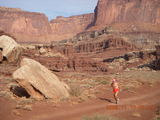 I wasn't born a runner.
I'm the wrong build and my childhood idea of exercise
was watching cartoon characters doing athletic things
on television.
When I was in junior-high school
(grades seven through nine in my district and time)
we had a gym teacher named Philip Finkeldey.
That name being too complicated for a bunch of seventh graders,
he went by the name Mr. Fink.
He coached the three "tough" sports, football, wrestling, and track,
and his theme in gym class was improvement.
One area was the 600-yard run (550 meters)
where a student got an automatic one-grade boost in his report card
for a ten-second improvement in his time between fall and spring.
One could "dog it" in the fall, but I never did.
I may have longed to run the Boston Marathon,
but it was enough just to run 600 yards without stopping.
I wasn't born a runner.
I'm the wrong build and my childhood idea of exercise
was watching cartoon characters doing athletic things
on television.
When I was in junior-high school
(grades seven through nine in my district and time)
we had a gym teacher named Philip Finkeldey.
That name being too complicated for a bunch of seventh graders,
he went by the name Mr. Fink.
He coached the three "tough" sports, football, wrestling, and track,
and his theme in gym class was improvement.
One area was the 600-yard run (550 meters)
where a student got an automatic one-grade boost in his report card
for a ten-second improvement in his time between fall and spring.
One could "dog it" in the fall, but I never did.
I may have longed to run the Boston Marathon,
but it was enough just to run 600 yards without stopping.
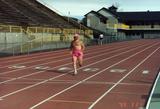 1970:
Mr. Fink took an interest in non-jock guys,
at least when we tried to be better.
It worked for me.
I ran 2:08 for the 600-yard run in ninth-grade fall
and ran the same event in our color-day competition
where they divide all the kids into Red and Blue teams
for a big athletic meet with all kinds of events.
Anybody within a mile heard Mr. Fink bellow with pride,
"One Fifty Two," when I crossed the finish line.
In case there were some night workers sleeping in the
nearby neighborhoods, he shouted it again, with more pride
in my effort.
That summer I went to the track and trained to run
an eight-minute mile.
1970:
Mr. Fink took an interest in non-jock guys,
at least when we tried to be better.
It worked for me.
I ran 2:08 for the 600-yard run in ninth-grade fall
and ran the same event in our color-day competition
where they divide all the kids into Red and Blue teams
for a big athletic meet with all kinds of events.
Anybody within a mile heard Mr. Fink bellow with pride,
"One Fifty Two," when I crossed the finish line.
In case there were some night workers sleeping in the
nearby neighborhoods, he shouted it again, with more pride
in my effort.
That summer I went to the track and trained to run
an eight-minute mile.
1971:
I was involved with the track team as its official "statistician"
(I kept the score during the meets),
but never became a member in junior-high school.
 1972:
Spring of my sophomore year a buddy on the cross-country team
was getting the usual ribbing from non-jocks
for spending his afternoons suffering instead of having fun.
Bob Cohen gave me the lecture,
"Well, at least I'm in shape.
I'll bet you a quarter you can't run an eight-minute mile."
We'll see about that.
1972:
Spring of my sophomore year a buddy on the cross-country team
was getting the usual ribbing from non-jocks
for spending his afternoons suffering instead of having fun.
Bob Cohen gave me the lecture,
"Well, at least I'm in shape.
I'll bet you a quarter you can't run an eight-minute mile."
We'll see about that.
1972:
With fifteen cents in side bets, the stakes were raised
to forty cents,
a good crowd of math weenies were out at the track,
and I won with a time of 7:35.
Bob even took me out running a few times after school
and I kept it up for several weeks.
1972:
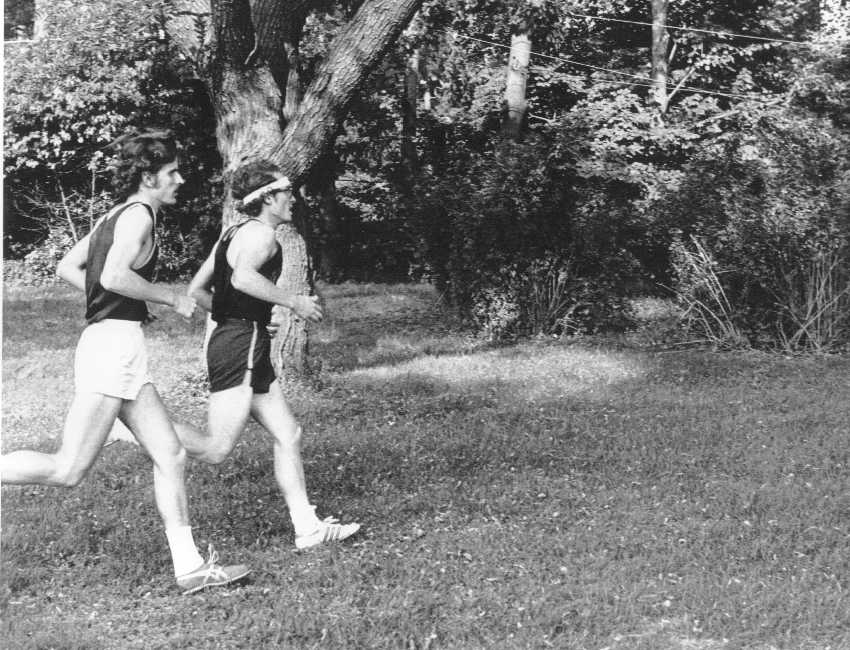
Tom Sexton, our cross-country coach, was truly desperate.
In 1971 he won two and lost twelve meets (2-12 record)
and was losing what senior-year talent he had on his team.
His shot at 1972 wasn't looking terribly good,
in fact it was a good shot at looking terrible.
So when he saw a slow, fat, orange-haired kid out there running,
he figured he would do what he could.
(As Bill Cosby would say here, "Are you ready for the lie?")
"You look pretty good out there,"
said Tom,
"Why don't you come out for cross-country?"
When I deferred that decision until the fall, he added,
"You have to come out in summer,
that's when we have all the fun."
Well, maybe running interval hills in the summer is fun for some,
it wasn't for me,
but I did all the summer runs and found the effort satisfying.
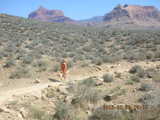 1972:
The cross-country season
lived down to its promise and we lost all fourteen meets (0-14).
Worse, I didn't even make the varsity team.
Our second team was called junior varsity (JV).
Our course meandered around the high school campus,
they said it was 2.5 miles, I ran it around sixteen minutes,
and more-accurate measurement revealed it to be 2.3 miles.
1972:
The cross-country season
lived down to its promise and we lost all fourteen meets (0-14).
Worse, I didn't even make the varsity team.
Our second team was called junior varsity (JV).
Our course meandered around the high school campus,
they said it was 2.5 miles, I ran it around sixteen minutes,
and more-accurate measurement revealed it to be 2.3 miles.
One lesson I learned as a competing athlete
is the difference between a run and a race.
The competing athlete's model of life is divided into three parts,
racing, training to race,
and living the rest of life around training.
Of course my life was more complex than this simple view,
but my athletic vision expanded to appreciate the difference
between competing and not-competing in my running.
A race is a magic moment demand all of me
while a training run is less than that,
typically run in anticipation of a race in the future.
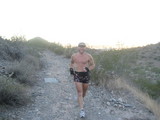 1973:
We didn't field a winter-track team
because our athletic director forgot
to send the $50 fee for membership
so I waited for spring track
where I was pushed out to the two-mile run.
(It was the equivalent of right field on the baseball team,
where you put a runner too slow to waste on a slot
in more-competitive events.)
I wallowed around twelve minutes while the team lost all its meets.
On top of that, I managed to get a sore left knee,
so I took June and half of July off from running.
1973:
We didn't field a winter-track team
because our athletic director forgot
to send the $50 fee for membership
so I waited for spring track
where I was pushed out to the two-mile run.
(It was the equivalent of right field on the baseball team,
where you put a runner too slow to waste on a slot
in more-competitive events.)
I wallowed around twelve minutes while the team lost all its meets.
On top of that, I managed to get a sore left knee,
so I took June and half of July off from running.
1973:
Cheltenham Cross-Country Coach Tom Sexton was desperate.
The good news is there's nowhere to go from 0-14 but up.
The bad news that that progress in that direction was elusive.
So he called a local coach in another league,
Coach Tom Donnelly at LaSalle High School,
and begged for help.
He figured the worst that could happen is
Coach Donnelly would laugh at him.
Tom Donnelly didn't laugh.
1973:
With Tom Donnelly's help and council,
Coach Sexton came up with a plan for our upcoming
cross-country season.
He told all of us to run miles,
lots of miles, and then some more.
Arthur Lydiard is credited with discovering the strange notion
that we can run faster races by doing lots of slow training.
(The abbreviation LSD for "long slow distance" came into being,
but I didn't hear that until I was in college.)
In 1973 August I ran 75 miles a week
including some long beach runs with my friend Gary
on Long Beach Island in New Jersey.
With cooperation from Gary's father driving us
and picking us up,
we did a twenty-one-mile run from
Barnegat Light to Holgate, the length of the island
(and a little extra going around the tip
because we didn't realize we were at the end).
It took three and a half hours.
I came back to high school leaner and meaner than before,
and so did my teammates.
 There's another lesson, I believe Arthur Lydiard is the messenger.
There's a "zen" concept that we often achieve one thing
better by aiming for something different.
When we train hard and fast for a hard, fast race, we achieve it,
but we achieve it better by training longer and slower, and easier.
Sharpening up that lost-slow-distance (LSD) base
with some tempo runs and interval training sure helps,
but the majority of training should be longer and slower
than the event on race day.
There's another lesson, I believe Arthur Lydiard is the messenger.
There's a "zen" concept that we often achieve one thing
better by aiming for something different.
When we train hard and fast for a hard, fast race, we achieve it,
but we achieve it better by training longer and slower, and easier.
Sharpening up that lost-slow-distance (LSD) base
with some tempo runs and interval training sure helps,
but the majority of training should be longer and slower
than the event on race day.
1973:
I've told the
story
of that season elsewhere,
but the short version is that our summer of lots of miles
paid off with six wins and six losses (6-6),
a winning season after the last few years.
Pride was in the air.
 1973:
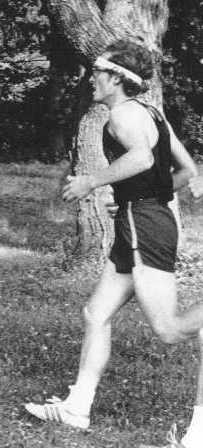
We celebrated our new strength with a new course,
longer and harder, three miles, longest in the league.
As our fifth man, I ran 17:45 for three miles.
That scores 94 on the Adam
fitness scale.
1973:
We celebrated our new strength with a new course,
longer and harder, three miles, longest in the league.
As our fifth man, I ran 17:45 for three miles.
That scores 94 on the Adam
fitness scale.
Indoor track was fun.
Coach Doug Scott would meet us at some appointed place
at oh-dark-hundred on a winter morning
and drive us in the van for an hour or two
to some college facility that would let us high-school kids
run a meet with several hundred competitors.
I did the two-mile run,
somewhere around twelve minutes (score=92)
on eleven-laps-to-the-mile wooden tracks.
Sometimes one of the curves would be through a tunnel.
We would get back after dark.
Doug was a quarter-miler, 47-flat I believe, pretty darned quick,
and I was a "minute man,"
destined never to run one lap (outdoors)
in less than sixty seconds.
We found ourselves evenly matched at about four miles
and we raced each other on a loop course from the high school
during the winter-track season.
It had a big hill on Mount Carmel Road at the midpoint
and a big downhill on Limekiln Pike back to the school.
With my endurance advantage, I could get a big lead up the hill,
but I needed a huge lead
to make up for his speed advantage coming home.
If he was in striking distance with half a mile to go,
then it was all over for me.
We both ran the four miles in about twenty-three minutes,
but very differently.
It was a lot of fun.
1974:
Spring track was outside on a 440-yard cinder oval.
Now just about all the tracks are synthetic ("tartan")
and they're 400 meters,
so there's an extra nine-and-a-third meters between
the end of the fourth lap and the finish for the mile run.
Coach Scott gave us the lecture, yet again,
reminding us that hard work was no guarantee of success,
but a lack of hard work was definitely a guarantee of failure.
Just as the weakest baseball player on a school team
plays right field,
the slowest runners got the two-mile run,
which I preferred anyway.
One time I had victory in my sights.
We were running against a team we almost shut out in cross country
and their distance team would have its better runners
doing the half-mile, the mile, and the mile relay,
so I had a shot.
I invited all my friends from the Math Team to watch my race.
When we were "mathletes" preparing for a competition,
we would do our own calisthenics, twenty-four permutations,
you know, "One two three four, One two four three,
One three two four, One three four two," all the way
to "Four three one two, Four three two one."
(Try doing all twenty-four in order like that
and you'll find it's not as easy as it seems.)
Anyhow, while I was on the backstretch of the track for my race
against Springfield's two-mile runners,
I heard the math guys chanting,
"One two three four, One two four three,"
it boosted my psyche, and I won that race.
There was a piece of string at the finish line
and I enjoyed having my chest reach it first in 11:08.
I eventually ran 11:01 for the two-mile race
for a 96 on the Adam fitness scale.
 I probably could have run a faster two-mile run with some strategy,
but I always went out the first quarter in 72 seconds.
It may not have been smart,
certainly not the negative splits they (rightly) recommend today,
but I figured if today was the day I was going to run ten minutes,
then I wanted to be there.
I probably could have run a faster two-mile run with some strategy,
but I always went out the first quarter in 72 seconds.
It may not have been smart,
certainly not the negative splits they (rightly) recommend today,
but I figured if today was the day I was going to run ten minutes,
then I wanted to be there.
I graduated Cheltenham High School with more math awards
than running awards,
but I left with a rich athletic experience.
Actually, I did win one trophy I'm very proud of.
Coach Sexton created an award which lives on forty years later,
the Most Improved Runner which I won.
"When he came out for the team,
if he'd been running any slower, he'd have been running backward,
and now he's our fifth man varsity."
Yes, I earned it.
It's a fair question,
why is a math-geek who never was in the running
for anything noteworthy in the running arena
running on so strongly in favor of running?
Even my glory days weren't that glorious,
ten miles in an hour and that's about it,
and yet here I am waxing lyrical about the sport.
There's no way the lifetime-benefit equation works out well,
any hope of living longer through better living
is wiped out by the fraction of that life spent exercising.
In 1978,
a friend who didn't particularly like exercise asked me
if I thought he should take of up running.
I told him, "Absolutely not, unless you enjoy it.
First, you're extending your life to do something you don't like doing,
second, you're trading off time in youth for time in old age,
and, third, you're trading off time in the twentieth century
for time in the twenty-first.
The last is no bargain from where I sit
as it's going to be awful."
(As awful as things looked thirty-six years ago,
they're not only worse than we did imagine,
they're worse than we can imagine,
but that's a discusson for another forum.
My point was, and still is, that running, or any sport actually,
is only worth doing because it's worth it in the present,
not just the future.)
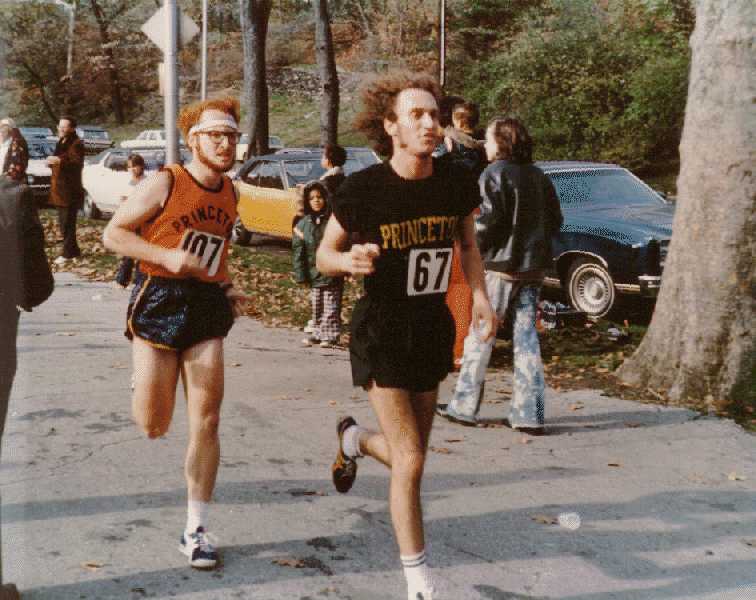
I got to Princeton after working a summer,
not much running,
and came out for the cross-country team.
They did one of their regular runs,
nine miles of rolling hills featuring Pretty Brook Road.
I was seriously left behind
by the third mile of the Pretty Brook run,
and the next day in the woods.
Clearly outclassed, I was offered the suggestion
that I run with "the slow half milers,"
not slow for two laps, but comparatively slow for longer distances,
or so they said.
 I asked the slow half milers just how slow they were.
Jeffrey Weiksel ran a 1:53,
Charlie Norelli ran a 1:51, and
Craig Masback ran a 1:49.
That didn't sound slow to me!
(Craig eventually ran a 3:52.1 mile
in the race where Sebastian Coe ran a world record
five seconds faster.)
I asked the slow half milers just how slow they were.
Jeffrey Weiksel ran a 1:53,
Charlie Norelli ran a 1:51, and
Craig Masback ran a 1:49.
That didn't sound slow to me!
(Craig eventually ran a 3:52.1 mile
in the race where Sebastian Coe ran a world record
five seconds faster.)
A senior named Paul Fisher befriended me,
we all called him "Fish,"
and introduced me to his home town of New York City.
We went for an eleven-mile run around Central Park
that ended with a twilight lap around the reservoir
when all the city lights came on.
To paraphrase Linda Ellerby,
if you ever want to hate New York City,
then don't do an evening run around the
Central Park reservoir in Manhattan.
Paul coaxed me into trying a marathon instead
of trying to be on the cross-country team.
Fish preached the current evangel of
long, slow distance (LSD).
I put it this way:
The "zero-order" idea that saving our bodies' limited resources
for a big athletic event by doing no exercise
obviously doesn't work.
The concept of needing training and exercise
so we adapt to an athletic task is apparent
to anybody doing any kind of sport.
The "first-order" idea that training by doing
what we're doing in competition
isn't entirely right either.
Quarter milers may train by running fast,
like the do in a race,
but they don't just repeatedly run one lap around the track
over and over again to get in shape.
New Zealand Coach Arthur Lydiard has his name
on the recent realization that we can get good at running fast
by running slow, just by running a lot.
That was what Tom Donnelly told
our coach Tom Sexton a year before
in high-school cross country
and that's what Fish was telling me now.
Run a lot, never mind if it's slow,
and running faster will come.
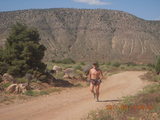 I got three decent weeks of running
with an easy "taper" week before the race,
243 miles for 1974 November.
Encouraged by my fitness level,
I wrote and offered Bob Cohen a bet for $6.56
(a quarter for each of 26.2 miles)
that I could break 3:29:45 (eight minutes per mile)
which he declined.
I got three decent weeks of running
with an easy "taper" week before the race,
243 miles for 1974 November.
Encouraged by my fitness level,
I wrote and offered Bob Cohen a bet for $6.56
(a quarter for each of 26.2 miles)
that I could break 3:29:45 (eight minutes per mile)
which he declined.
I made a transition from running in the afternoons
to being a morning runner,
doing my long distances before breakfast.
I've been that way ever since.
I did the depletion and carbo-load thing the last week
and got on the starting line
1974 December 1 for the Philadelphia Marathon,
three laps around the art museum
(later made famous by Sylvester Stallone in "Rocky")
along the East River Drive,
over the Falls River Bridge,
a short way on the West River Drive,
and back.
My father and sister were there,
the first time any member of my family watched me run a race.
It was a rainy, sleety day with a stiff crosswind
running along the river.
I remember coming down a hill on the West River Drive
at 22.2 miles feeling terrific,
"this is a good start for a hundred-mile week,"
and then I hit the proverbial "wall."
It started with a sharp pain in my arms as I came up off one foot
and spread down to my whole body as I came down on the other.
It didn't hurt particularly more to run faster
or less to run slower,
so I figured I wanted to get to the finish line sooner
to get this over with.
I ended up finishing in 3:12:36,
7:21 per mile (4:34 per kilometer)
103 points on my fitness scale.
I think I managed a whoop of satisfaction and joy at the end,
and then I was hobbling for about a week afterward.
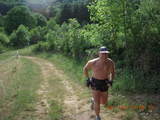 I had difficulty moving around after that,
going down stairs was the worst,
and it took me about a week to get running again.
During that week I had withdrawal symptoms
going from 80 miles per week to zero.
I didn't sleep and couldn't stay awake
and I needed my fix.
Sunday morning I woke a up Fish to do thirteen miles with me
in the pouring rain,
the friend who goaded me into the marathon and then
asked, afterward, "Did you hit a brick wall?"
I had difficulty moving around after that,
going down stairs was the worst,
and it took me about a week to get running again.
During that week I had withdrawal symptoms
going from 80 miles per week to zero.
I didn't sleep and couldn't stay awake
and I needed my fix.
Sunday morning I woke a up Fish to do thirteen miles with me
in the pouring rain,
the friend who goaded me into the marathon and then
asked, afterward, "Did you hit a brick wall?"
1975:
My right shin was sore afterward,
worse during and after running,
I happened to be back in Philadelphia,
and I stopped by to see my old gym teacher, Mr. Fink.
He was suitably impressed by my accomplishment the month before
at the marathon and
by my "good pair of legs."
As he was quite knowledgeable about athletic anatomy,
I asked him about my shin,
he ran his finger along it,
I yelped in pain, and he said,
"Yup, it's a shin splint."
Shin splints are typically associated with running on hard surfaces
and I did almost all my training on roads.
Mr. Fink cut a piece of felt for me and
an ace bandage to press it against my sore shin.
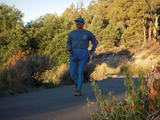 Starting the beginning of 1975 February
I found myself at a new level of fitness.
Thirteen mile morning runs were coming in around 85 minutes
and I had a hilly 9.3-mile run (15 Km) that took an hour.
One good morning I ran fifteen miles in an hour and a half,
117 on my fitness scale.
I had a qualifying time for the Boston Marathon as
my 3:12 was under 3:30.
(At eighteen, I was a year too young for the race,
so I had to lie about that on the entry blank.)
I felt I was right on track for a 2:50 marathon.
Starting the beginning of 1975 February
I found myself at a new level of fitness.
Thirteen mile morning runs were coming in around 85 minutes
and I had a hilly 9.3-mile run (15 Km) that took an hour.
One good morning I ran fifteen miles in an hour and a half,
117 on my fitness scale.
I had a qualifying time for the Boston Marathon as
my 3:12 was under 3:30.
(At eighteen, I was a year too young for the race,
so I had to lie about that on the entry blank.)
I felt I was right on track for a 2:50 marathon.
I remember one morning,
or maybe a mix of a few mornings,
waking up four miles from campus,
moving six and a half minutes per mile along a country road
in New Jersey.
(The route was from Princeton along Quaker Bridge Road
continuing to Province Line Road and returning
on Pretty Brook Road.
This was before the mall turned the fourth and fifth miles
into a shopping-mall-traffic route.)
The route was thirteen miles (21 Km)
with lots of fields on the east side of the roadways,
perfect for a morning run, perfect for sunrise.
I remembered seeing a hint of red on the east side of the road
a couple of miles earlier, still mostly asleep,
and the world was still dark, still black and gray.
The moment came,
just like for Dorothy in "The Wizard of Oz,"
when black-and-white breaks into full color,
the gray leaves on the trees turn green
and the lighter-gray sky turned blue.
A flock of geese flew overhead and disappeared somewhere,
out of sight but still noisy.
The road ran alongside the canal
(where mules used to tow barges, or that's what they told us)
and I saw a lake on my right where all the geese had landed
and were honking up a storm.
The road ran through some suburban-rural areas,
there were houses on the west side and fields on the east,
and about nine miles along, not quite an hour into my run,
the sun itself rose in its orange-red glory.
The next three miles were rolling hills as I picked up my pace,
exhausted and exhilerated by my effort.
Finally, the last mile was along a sidewalk of a busy street,
doing my dance between turning cars
(banging on the hoods and trunks of some who didn't
use turn signals, when I could reach them)
and flying under ninety seconds for the last quarter mile
to the courtyard where my finish line was.
A runner's life can be very good.
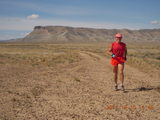 I got used to an athletic lifestyle
that has been with me for four decades.
It's all about the six Ps
starting with Persistance and Perspiration,
as in determination and sweat.
If you want something, then you have to work for it.
You may not get it, but you're certainly not going to get it
if you don't try hard and work hard.
I got used to an athletic lifestyle
that has been with me for four decades.
It's all about the six Ps
starting with Persistance and Perspiration,
as in determination and sweat.
If you want something, then you have to work for it.
You may not get it, but you're certainly not going to get it
if you don't try hard and work hard.
It goes deeper than effort bringing about goals.
After a while, the effort itself becomes the reward.
Getting up each morning and watching the sun rise
(or running in the rain sometimes)
becomes its own reward, its own satisfaction.
Recently, my friend Sean mentioned he didn't like sweat.
At that time, I was bicycling an hour each way to and from work
and running an hour and a half on top of that,
so three and a half hours of my day were spent
sticky with sweat—I loved it!
The other four Ps are the inevitable biological consequences
of dragging a human body through physical effort,
Piss, Poop, Puke, and Pain.
Managing where I can "take a leak" on a two-hour run
is an issue in an urban setting.
(I had my piddle spots picked out
when I ran each morning in Montréal's Centre-Ville.)
Making sure my bowels are empty before starting a run
means managing when and what I can eat beforehand.
Making sure my stomach is empty before running,
especially before hard runs or races,
is crucial to avoid having it empty itself.
I've been lucky enough only to get dry heaves a couple of times.
Non runners don't understand our obsession with these bodily functions,
but they're a fact of life,
like long-distance drivers worrying about gas stations and food stops
or pilots and sailors worrying about wind and weather.
It's not the glamor part of life, but it's a crucial part of the game.
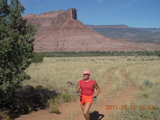 And that leaves pain, the sixth P on my list.
Pain is part of the process.
We live with it, we deal with it, we train through it,
and the ability to endure physical discomfort
is often what makes the difference
between winning and losing a race.
There are milk-and-cookies workouts of long, easy, comfortable running
and there are
liver-and-onions workouts that are simply endured.
Sore muscles and gasping lungs hurt
during hill repeats, interval workouts,
and even those long, hard, "tempo" runs I enjoy so much.
And that leaves pain, the sixth P on my list.
Pain is part of the process.
We live with it, we deal with it, we train through it,
and the ability to endure physical discomfort
is often what makes the difference
between winning and losing a race.
There are milk-and-cookies workouts of long, easy, comfortable running
and there are
liver-and-onions workouts that are simply endured.
Sore muscles and gasping lungs hurt
during hill repeats, interval workouts,
and even those long, hard, "tempo" runs I enjoy so much.
It's a wonderful feeling being in running shape
as I was in 1975 February and March.
The only pain I felt was injury,
when I pulled something or hurt something,
and I enjoyed what they later called "runner's high"
on my longer runs.
I got on the starting line of Boston ready for a great race.
I even got new shoes for the occasion (not such a great idea).
I lost a minute at the Boston starting line,
2400 runners on a two lane road,
not to mention three bathrooms for 2400 runners,
so I reached the mile mark in seven minutes instead of six.
Thinking I was too slow, I picked it up and saw
the three-mile mark in nineteen (actually eighteen) minutes.
I realized the river of bright-colored running outfits ahead of me
went a mile ahead of me as the top guys were under five-minute pace.
My feet were starting to hurt from blisters from my new shoes.
I managed to reach ten miles in 61 and the halfway point in 82
(so I ran half a marathon in 81 minutes, score 111)
and crawled my way home to the Prudential building in 3:09.
(The slowdown and line-up at the finish with their new computer system
got me an official time of 3:12, same as Philly.)
I was pretty upset.
 1975:
I had a lot of left-knee pain my last summer in high school
and that came back with a vengeance during my high-mileage training.
I had tried a cortisone shot in high school
and the "cure" lasted about four miles into my next run.
The problem wasn't the injury,
it was an underlying condition of my running.
I heard about a "revolutionary" notion
that foot plant affects running injuries.
Today we say, "duh, it's obvious," but it wasn't then.
I drew magic-marker lines on my shoes to see where they were wearing
and the marker lines wore differently than the shoe wear from
when it didn't hurt.
They have tennis elbow and even Frisbee finger,
so why not runner's knee?
I heard about Dr. Richard Schuster,
a podiatrist who treated runners
with "inserts" (officially called "orthotics")
that go between foot and shoe to align a runner's foot plant.
It's not terribly different than the notion that a lens
in front of an eye can put the image into focus.
Either solution sure beats surgery, or even painful cortisone shots.
After a few weeks walking around in the new inserts,
the first run was agonizingly painful
with pressure in places my foot wasn't used to having pressure.
The knee problem didn't go away right away,
it took a couple of adjustments,
but orthotics gave me over thirty-years of no-knee-pain running.
(The one time I got some knee pain,
the inserts had worn down and needed more material put back in.
Orthotics were leather and cork in those days,
now they use hard, flexible plastics that don't wear out.)
1975:
I had a lot of left-knee pain my last summer in high school
and that came back with a vengeance during my high-mileage training.
I had tried a cortisone shot in high school
and the "cure" lasted about four miles into my next run.
The problem wasn't the injury,
it was an underlying condition of my running.
I heard about a "revolutionary" notion
that foot plant affects running injuries.
Today we say, "duh, it's obvious," but it wasn't then.
I drew magic-marker lines on my shoes to see where they were wearing
and the marker lines wore differently than the shoe wear from
when it didn't hurt.
They have tennis elbow and even Frisbee finger,
so why not runner's knee?
I heard about Dr. Richard Schuster,
a podiatrist who treated runners
with "inserts" (officially called "orthotics")
that go between foot and shoe to align a runner's foot plant.
It's not terribly different than the notion that a lens
in front of an eye can put the image into focus.
Either solution sure beats surgery, or even painful cortisone shots.
After a few weeks walking around in the new inserts,
the first run was agonizingly painful
with pressure in places my foot wasn't used to having pressure.
The knee problem didn't go away right away,
it took a couple of adjustments,
but orthotics gave me over thirty-years of no-knee-pain running.
(The one time I got some knee pain,
the inserts had worn down and needed more material put back in.
Orthotics were leather and cork in those days,
now they use hard, flexible plastics that don't wear out.)
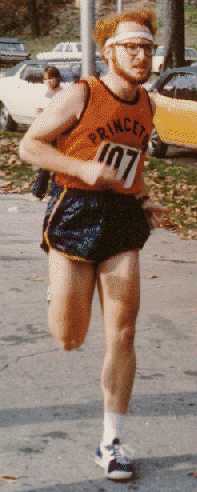 1975:
I ran yet another 3:12 at Philadelphia
and never got it together for a spring marathon in 1976.
1975:
I ran yet another 3:12 at Philadelphia
and never got it together for a spring marathon in 1976.
1976:
"Fish" came to visit one afternoon.
I had run 13½ miles that morning,
but running with Paul was a privilege not to be forgone
and the thirteen miles of Quaker-Pretty-Brook was our favorite
together, memories and all that.
It wasn't terribly fast and,
as we came back towards campus,
Paul said, "Where's the marathon of your day?"
Nerd that I am, he know I would know, I did, and I told him.
"Do you want to do a mock finish?"
Of course, so the two of us were running, after dark,
as fast as I could go, which wasn't very fast,
maybe seven and a half minutes a mile,
with Shorter and Viren and maybe Bill Rodgers on our tail,
trying to close the gap with the crowd on its feet
stamping feet and yelling, to no avail.
Our victory was assured,
hands high and chests thrown forward in the air on a street corner
with nobody else around.
A runner's friendships can be very good.
1976 November:
The New York City Marathon
changed from four loops around Central Park
to a five-borough course.
Entry fees were higher, seven dollars instead of Boston's three,
but it included a t-shirt and a metal serving plate with race info.
There was a medical-scientific Conference on the Marathon
from the New York Academy of Sciences right after the race,
so I limped from one session to another.
I got to meet Ted Corbitt.
I ran my personal record (PR) in the marathon that day,
3:03:30, which works out to 6:59.9 per mile
and I don't round it off to seven minutes.
It wasn't a perfect race,
86 minutes for the first half
and 97 minutes coming home,
but I'm proud of it.
I believe I was 358th
of 2002 starters and about 1600 finishers.
One point that came up in the conference was the difference
between dissociative and associative running.
I tend to train in a dissociative way,
thinking about anything but my running.
I look around at the scenery
while I'm solving math problems in my head.
Sometimes I talk through an upcoming confrontation,
tell myself stories, or even sing a song or two.
My tempo runs are mostly associative,
looking at times and distances,
evaluating how I'm doing,
thinking about little other than my running.
Often I'll put mental markers on my run for points
on an upcoming race—the last three miles of my tempo run
is going to be the three-mile race at Curtis Arboretum
in two weeks.
The first quarter, the hill loop, crossing the bridge,
the lower loop, the hill loop again, and the last quarter
are all visualized in my training run.
A race, of course, is all associative, all attention is paid
to the race itself.
I did not get my act together for another marathon for several years.
I ran at Stanford, but never got to marathon mileage.
I ran at Bell Laboratories in New Jersey, but never marathon mileage.
In 1985 October I messed up my back
carrying my luggage from one terminal to another
at Newark Airport (EWR) and on 1986 February 14
I sneezed at 2am and popped the lowest disk in my back.
I had twenty-one hours of real pain in my lower back
radiating down my legs.
It took six months before I could run three miles,
which I seriously wanted to do,
as Cheltenham High School Cross Country had its first alumni race
at Curtis Arboretum, 1986 September 6,
the Saturday after Labor Day.
 I started flying light airplanes in 1986 August,
flew my first solo 1986 December 7,
got my private-pilot certificate in 1987 May,
and sometime around 1990 I started doing
fly-and-run combinations.
I would take my airplane to a far-away place and run there.
Many pilots fly someplace for lunch,
we call it the $100 hamburger (from when rentals were cheaper),
and I call my combination hobby
"a $100 hamburger without the cholesterol."
I remember one run in particular, 1990 November 25,
a flight to Gettysburg, Pennsylvania, with my friend Andy,
an eight-mile run on the rolling hills of Civil-War battlefields.
I started flying light airplanes in 1986 August,
flew my first solo 1986 December 7,
got my private-pilot certificate in 1987 May,
and sometime around 1990 I started doing
fly-and-run combinations.
I would take my airplane to a far-away place and run there.
Many pilots fly someplace for lunch,
we call it the $100 hamburger (from when rentals were cheaper),
and I call my combination hobby
"a $100 hamburger without the cholesterol."
I remember one run in particular, 1990 November 25,
a flight to Gettysburg, Pennsylvania, with my friend Andy,
an eight-mile run on the rolling hills of Civil-War battlefields.
1991:
I found myself gaining girth and running slower because of it.
I decided to skip meals, to eat lower-calorie foods,
and to train harder in hope of getting my act together.
I got down to the same weight, if not the same performance,
as 1976 when I ran my 3:03 marathon.
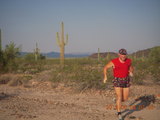 I got my act together in April and ran the Glass City Marathon
in Toledo, Ohio, in 3:28:45, still under eight-minute pace.
A buddy named Kevin ran with me, at least on his easy days.
We shared long runs on the weekends and quarter-mile intervals
on the local high school track.
He had family in Pepin, Wisconsin, near the twin cities,
I had a new job in Saint Paul,
I have family in Toledo,
so Kevin and I drove my car to the marathon, ran it,
and continued to his family visit and my new home.
A marathon in 3:28:45 is 95 points on my scale.
I got my act together in April and ran the Glass City Marathon
in Toledo, Ohio, in 3:28:45, still under eight-minute pace.
A buddy named Kevin ran with me, at least on his easy days.
We shared long runs on the weekends and quarter-mile intervals
on the local high school track.
He had family in Pepin, Wisconsin, near the twin cities,
I had a new job in Saint Paul,
I have family in Toledo,
so Kevin and I drove my car to the marathon, ran it,
and continued to his family visit and my new home.
A marathon in 3:28:45 is 95 points on my scale.
I ran a couple of half-marathon races in 96 minutes
and 94:30, also 95 points on my scale.
One of those was in Dayton, Ohio,
with my cousin who was living there at the time.
1991 September 7, the Saturday after Labor Day,
we run our sixth annual Cheltenham alumni race at Curtis
and I came in tenth place in 19:42 out of thirty runners,
just two minutes off my high-school varsity time.
It was a smart race, nearly last place at the quarter-mile
and graduatlly passing one runner after another the entire race.
As I was never a great runner, even at my peak,
being beaten my The Adam was embarrassing and humiliating
and I can assure you these guys came back in 1992 September
leaner and meaner and fitter than ever.
My 19:42 was an inspiration!
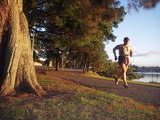 In 1991 December I ran the first of eight
Rocket-City Marathons in Huntsville, Alabama in 3:35.
My times for those slipped to 4:09 over several years
and I came back in 2001 December with a 3:50 effort.
In 1991 December I ran the first of eight
Rocket-City Marathons in Huntsville, Alabama in 3:35.
My times for those slipped to 4:09 over several years
and I came back in 2001 December with a 3:50 effort.
2001:
Once again I found myself bigger than I wanted to be.
I was able to run seventy miles in a week without losing weight,
not a good combination.
They offered an at-work Weight-Watchers program and I joined it.
I found four things that helped me there:
They gave me a scoring system and a budget of food I could eat,
they taught me to write down everything I ate,
they gave me tips and pointers how to manage appetite
in my sedentary lifestyle,
and
they gave me a community of people meeting once a week
to share a common goal.
I got down to a weight somewhat less than my best-marathon weight,
less muscle rather than less fat I expect.
I ran the three-mile cross-country course at Curtis in 20:02
that year and the 3:50 marathon in Huntsville.
 2002:
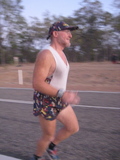
The Silver Comet half marathon
was the closest I've ever come to the perfect race.
We all dream about that moment of running
the absolutely perfect race,
the fastest race we can run on a given day.
I did the first mile in eight minutes
and each mile was a little bit faster than the one before,
so I was strong and relatively fresh throughout the race.
Ten miles went by in 76½ minutes
and the last 5000 meters took 22½ minutes
with the last mile right on seven minutes
for a total of 99:05.
(That's 91 on my fitness score.)
It was a super race on a super day
and I'd give a lot to be able to run that time again.
2002:
The Silver Comet half marathon
was the closest I've ever come to the perfect race.
We all dream about that moment of running
the absolutely perfect race,
the fastest race we can run on a given day.
I did the first mile in eight minutes
and each mile was a little bit faster than the one before,
so I was strong and relatively fresh throughout the race.
Ten miles went by in 76½ minutes
and the last 5000 meters took 22½ minutes
with the last mile right on seven minutes
for a total of 99:05.
(That's 91 on my fitness score.)
It was a super race on a super day
and I'd give a lot to be able to run that time again.
I moved to Scottsdale 2003 October 8 for my new job there
and started running every morning before my walk to work,
just as I did in Atlanta.
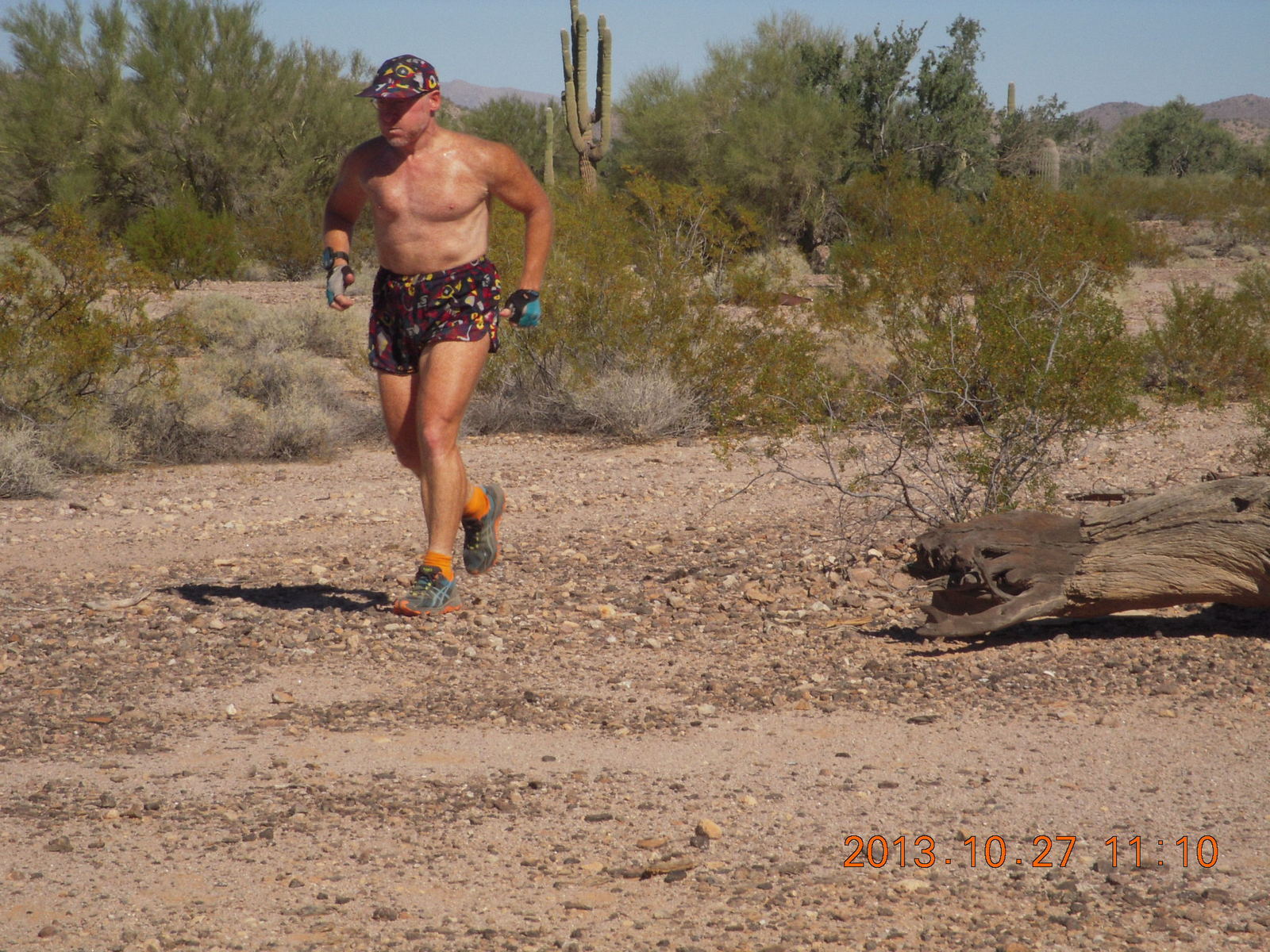
I also found remote places in Arizona for my fly-run adventures,
and I started going to
Utah
national parks regularly.
Maybe I didn't run any more marathons,
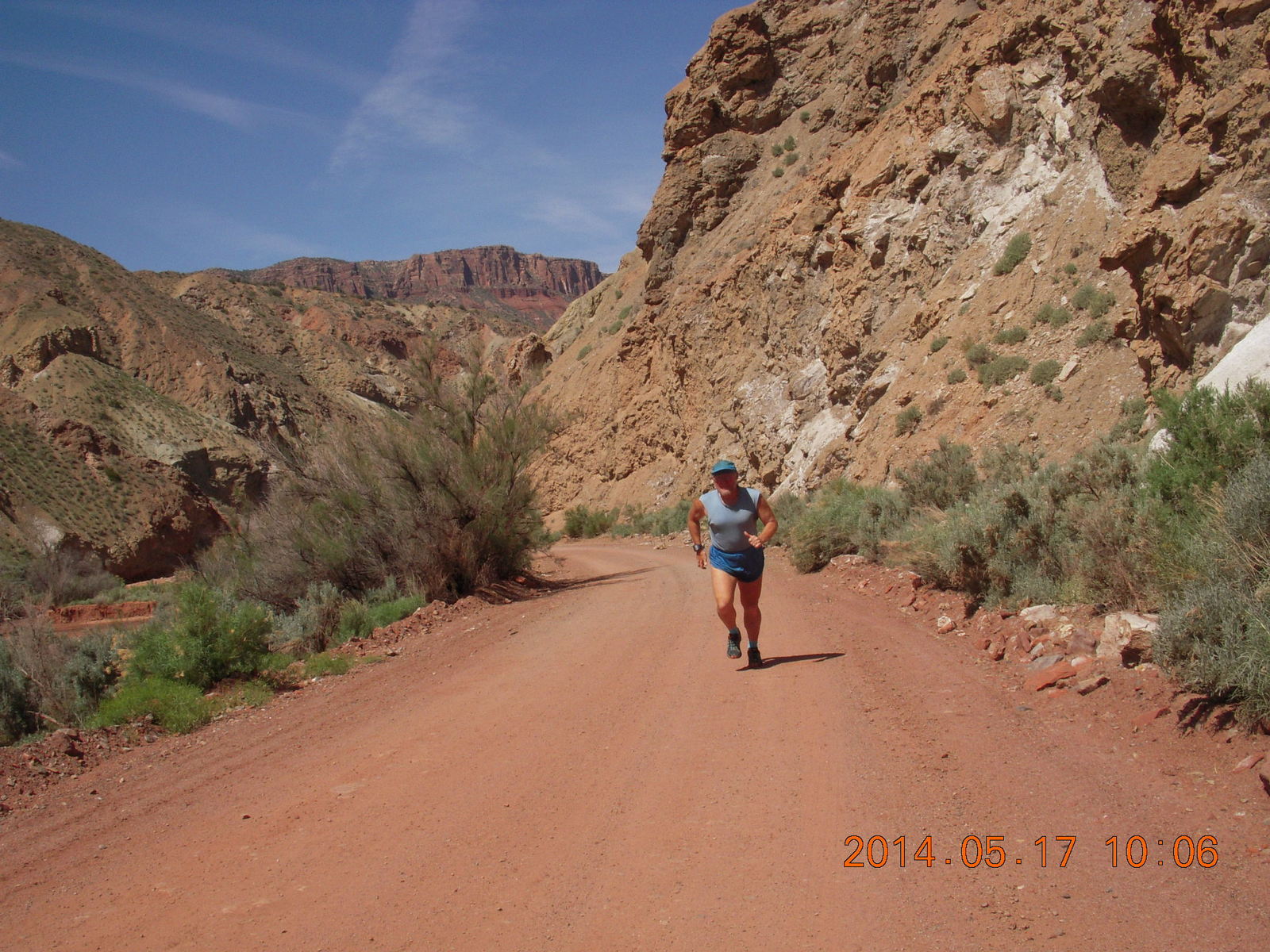
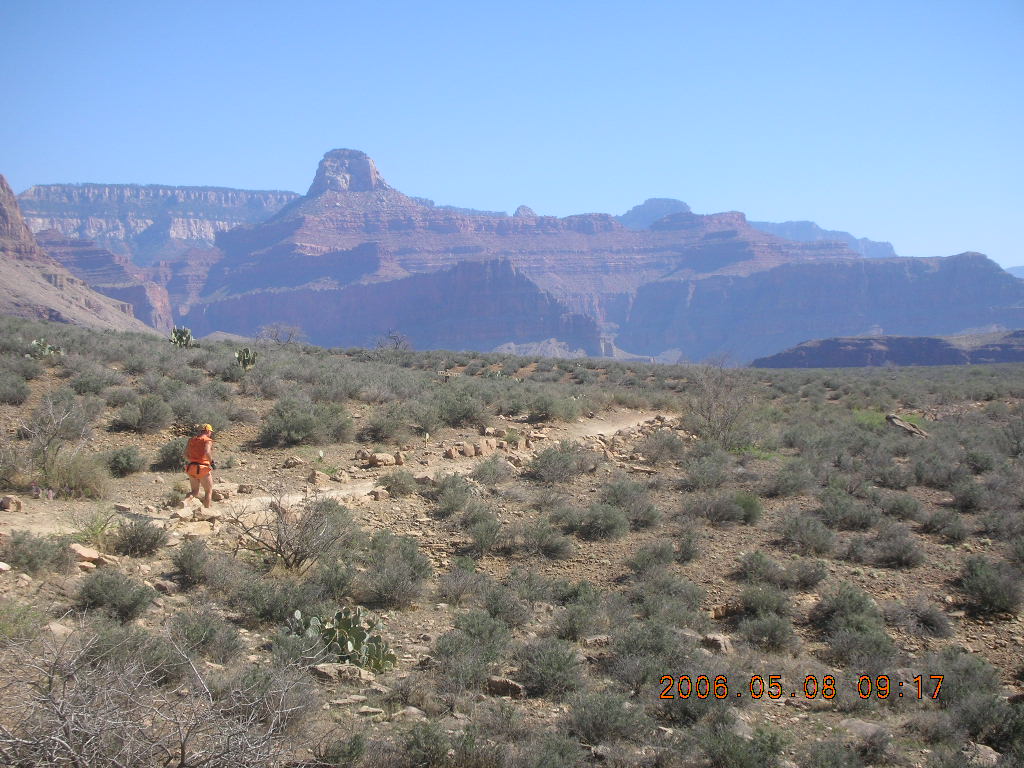
but I did make it twice to the bottom of the Grand Canyon, and back up.
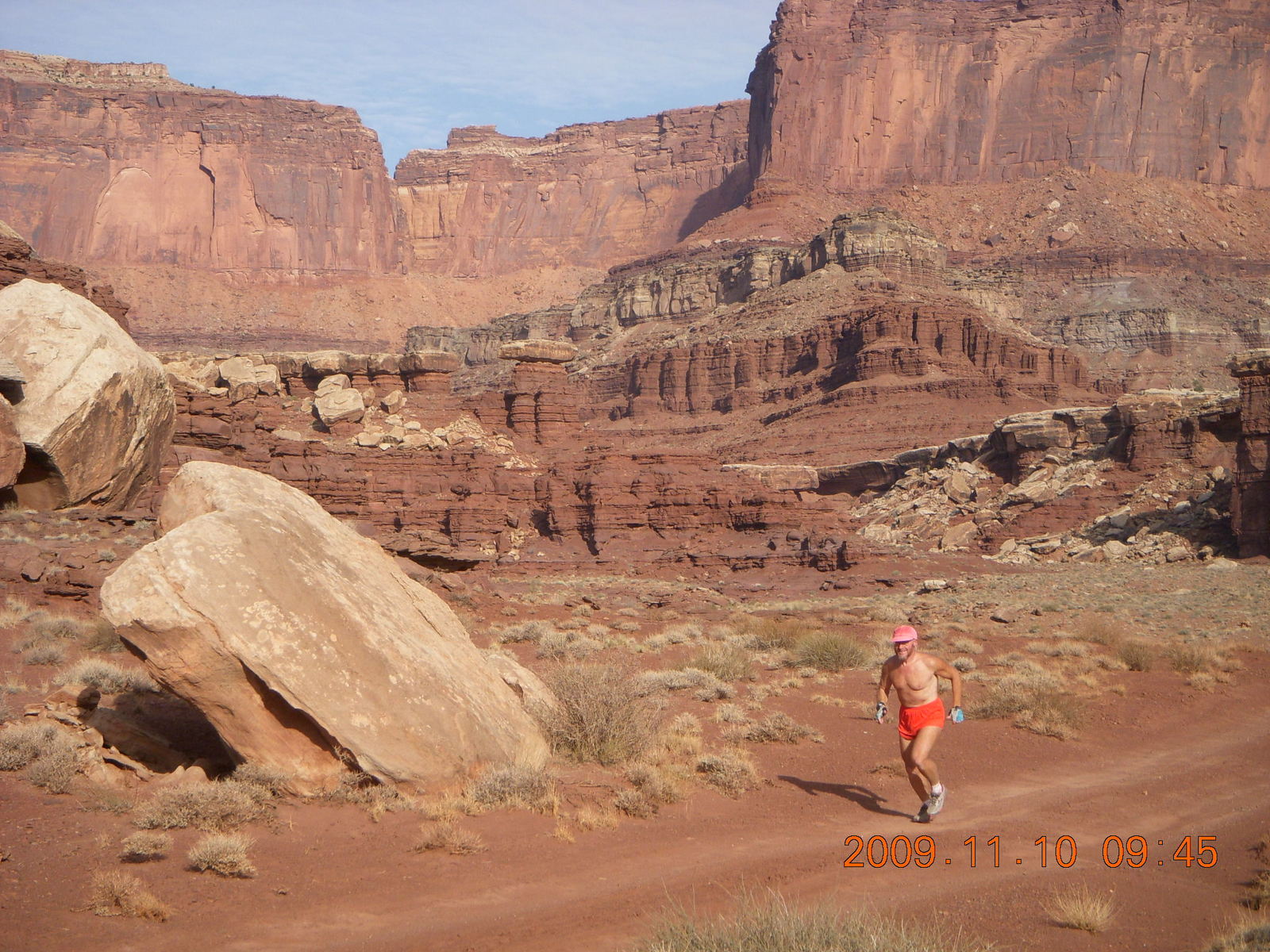
My favorite effort has been a twenty-two mile run-hike-run-hike-run
adventure at the Lathrop Trail at Canyonlands National Park,
eight to ten hours of astonishing beauty and seriously-intense effort,
especially the climb back up to the Island in the Sky.
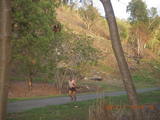 I bought a shoebox-house in Scottsdale
to be within a short walk of work.
They moved the office from McCormick Ranch
to Old Town Scottsdale 2004 June 25, Friday.
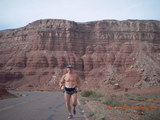
I celebrated the day off by flying to the dirt airstrip
Tuweep
where I could run 12 Km (7.5 miles) each way
to the Toroweap viewpoint on the north rim of the Grand Canyon.
The forecast 32°C (90°F) turned out
to be 38°C (100°F) and I had a hard time running back.
At least I had a good supply of water waiting for me
in my airplane.
I bought a shoebox-house in Scottsdale
to be within a short walk of work.
They moved the office from McCormick Ranch
to Old Town Scottsdale 2004 June 25, Friday.
I celebrated the day off by flying to the dirt airstrip
Tuweep
where I could run 12 Km (7.5 miles) each way
to the Toroweap viewpoint on the north rim of the Grand Canyon.
The forecast 32°C (90°F) turned out
to be 38°C (100°F) and I had a hard time running back.
At least I had a good supply of water waiting for me
in my airplane.
About seven years ago I started having injuries
after decades of injury-free running.
It wasn't necessarily good running,
but there were no pulled muscles or ailing knees
like some of my friends had to deal with.
Out of the blue came a pulled hamstring.
I muddled through my runs with it for a couple of months figuring
(1) it might be phantom pain from my lower-back issues or
(2) it might go away on its own.
When leg curls hurt in the same place,
I gave up the notion of phantom pain and looked for a doctor.
The trouble with going to a doctor and saying,
"It hurts when I do that,"
is he's likely to say, "Don't do that."
That's not the answer I'm looking for.
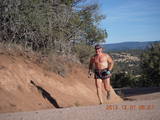 One friend recommended physical therapy (PT)
and another recommended Torrey Foster
at Spooner in Scottsdale.
I've been in and out of that place for seven years
with various aches and pains that didn't get better on their own.
Not every injury lasted long enough to get me to PT.
I had two painful left-calf-muscle pulls
that hurt like the devil but went away in a few days.
My PT procedure is always the same.
A few massages and stretches with the doctor
(where he's constantly assessing the state of my injury),
usually with explanation of what he's observing,
and then a sequence of exercises with assistants.
The "office" is a gymnasium with exercises that look silly
but are designed to work on specific weaknesses.
A couple of times the doctor's treatment included
electric shocks to stimulate muscles into contracting.
The massages and stretches tend to be uncomfortable
and the exercises are things I don't like to do.
I figure it this way:
If I were comfortable stretching and bending and exercising that way,
then I wouldn't have the injury I have.
One friend recommended physical therapy (PT)
and another recommended Torrey Foster
at Spooner in Scottsdale.
I've been in and out of that place for seven years
with various aches and pains that didn't get better on their own.
Not every injury lasted long enough to get me to PT.
I had two painful left-calf-muscle pulls
that hurt like the devil but went away in a few days.
My PT procedure is always the same.
A few massages and stretches with the doctor
(where he's constantly assessing the state of my injury),
usually with explanation of what he's observing,
and then a sequence of exercises with assistants.
The "office" is a gymnasium with exercises that look silly
but are designed to work on specific weaknesses.
A couple of times the doctor's treatment included
electric shocks to stimulate muscles into contracting.
The massages and stretches tend to be uncomfortable
and the exercises are things I don't like to do.
I figure it this way:
If I were comfortable stretching and bending and exercising that way,
then I wouldn't have the injury I have.
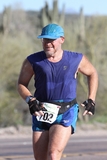 With the longer commute to work,
my walk to work turned into a bicycle ride
which I have maintained in my work since then,
except for one month of consulting.
It's 8 Km from McCormick Ranch to Old Town
in Scottsdale.
For fifteen months in 2010 and 2011 I worked
for US Airways in Tempe,
18 Km (11.2 miles) by bicycle.
(My Ironman-triathlon buddies do 112 miles in their bike leg,
I biked 112 miles each week in ten rides to and from work.)
I found a bike shop called the Bicycle Cellar
just 500 meters from company headquarters where I worked.
The Bicycle Cellar offered bicycle storage
along with lockers and showers, the perfect arrangement.
I can get away with five miles each way,
even with our warm summer mornings,
but eleven miles requires a shower before work.
Often I took advantage of the opportunity to run there
intead of home.
My typical day was an hour bicycling to Tempe,
an hour and a half running there,
a shower at the Bicycle Cellar,
eight or nine hours at work,
and an hour bike ride home.
I'm not a multi-sport athlete,
but I led a multi-sport life,
complete with my Wednesday-morning weight workouts
at Club SAR near Old Town, halfway to Tempe.
There was a nice 18 Km (11 mile) run from Club SAR
that took me out along the canal into Indian land
(native American rather than the sub-continent in Asia).
With the longer commute to work,
my walk to work turned into a bicycle ride
which I have maintained in my work since then,
except for one month of consulting.
It's 8 Km from McCormick Ranch to Old Town
in Scottsdale.
For fifteen months in 2010 and 2011 I worked
for US Airways in Tempe,
18 Km (11.2 miles) by bicycle.
(My Ironman-triathlon buddies do 112 miles in their bike leg,
I biked 112 miles each week in ten rides to and from work.)
I found a bike shop called the Bicycle Cellar
just 500 meters from company headquarters where I worked.
The Bicycle Cellar offered bicycle storage
along with lockers and showers, the perfect arrangement.
I can get away with five miles each way,
even with our warm summer mornings,
but eleven miles requires a shower before work.
Often I took advantage of the opportunity to run there
intead of home.
My typical day was an hour bicycling to Tempe,
an hour and a half running there,
a shower at the Bicycle Cellar,
eight or nine hours at work,
and an hour bike ride home.
I'm not a multi-sport athlete,
but I led a multi-sport life,
complete with my Wednesday-morning weight workouts
at Club SAR near Old Town, halfway to Tempe.
There was a nice 18 Km (11 mile) run from Club SAR
that took me out along the canal into Indian land
(native American rather than the sub-continent in Asia).
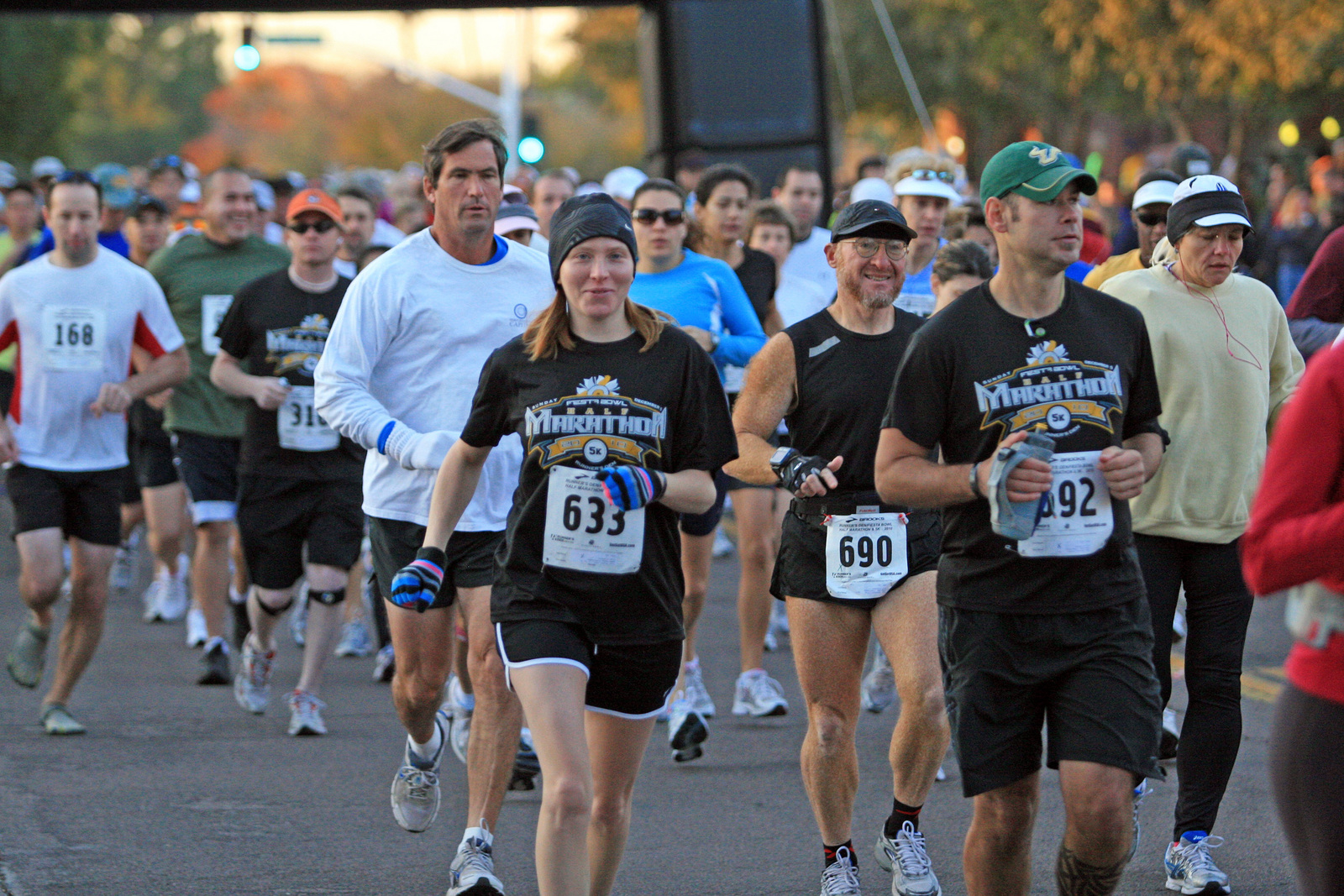
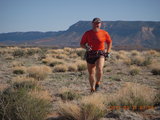 2010 October 30 I ran a half-marathon race in 1:53:47
at Safford Airport (SAD), a wonderful fly-run adventure,
and a score of 79 on my fitness scale.
It was a race of about fifty runners,
so I was able to come in seventh place.
After I passed the runner in seventh ahead of me,
I could see the runner in sixth place,
but there was no way I was going to catch him.
Safford gave out medals
(made of plastic, actually)
for the first twenty-five places,
so this is one of the very few times
I won a medal running faster than somebody else.
Sure, we all get medals for finishing races
(the New York City marathon in 1976 was my first),
but this was an actual beat-somebody-to-the-finish-line award.
2010 October 30 I ran a half-marathon race in 1:53:47
at Safford Airport (SAD), a wonderful fly-run adventure,
and a score of 79 on my fitness scale.
It was a race of about fifty runners,
so I was able to come in seventh place.
After I passed the runner in seventh ahead of me,
I could see the runner in sixth place,
but there was no way I was going to catch him.
Safford gave out medals
(made of plastic, actually)
for the first twenty-five places,
so this is one of the very few times
I won a medal running faster than somebody else.
Sure, we all get medals for finishing races
(the New York City marathon in 1976 was my first),
but this was an actual beat-somebody-to-the-finish-line award.
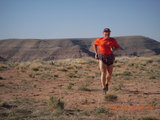 The Safford race was terrific, at least for me.
We went out three miles on a paved road with gently-rolling hills
and then turned onto a dirt road
that climbed, also gently, for five miles.
The footing was a little rough on that stretch,
but the mountains in the distance and the open desert
made for nice scenery,
for the few minutes I spent looking at scenery.
It was cool being near the back of the pack at three miles
and gradually picking off one runner and another and another
until I found with the runner ahead of me
definitely out of reach for the final mile and change.
The Safford race was terrific, at least for me.
We went out three miles on a paved road with gently-rolling hills
and then turned onto a dirt road
that climbed, also gently, for five miles.
The footing was a little rough on that stretch,
but the mountains in the distance and the open desert
made for nice scenery,
for the few minutes I spent looking at scenery.
It was cool being near the back of the pack at three miles
and gradually picking off one runner and another and another
until I found with the runner ahead of me
definitely out of reach for the final mile and change.
At this point I was still running well,
even if I had to add those three dreadful words,
"for my age."
Since then I've been slipping away faster than I think
age would explain.
It's a far steeper decline than I had up until 2010
when I ran 22:17 for three miles at Curtis.
My doctor hasn't found anything wrong.
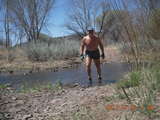 If I can't run long or fast,
then maybe at least I can endure.
I started competing in 1972 September
(high school cross country),
earlier if you count that I actually trained for
(and cared about)
my 600-yard run-races for Mr. Fink.
That means I've been out there pounding pavement,
grassy greens, and desert trails for forty years and change.
Wow, doesn't that sound like a long time.
Some people have running streaks, not missing a day in so-many years.
I can't claim that,
but I've made all twenty-eight cross-country-alumni races
at Cheltenham High School
(even though I haven't lived in Pennsylvania any of that time).
If I can't run long or fast,
then maybe at least I can endure.
I started competing in 1972 September
(high school cross country),
earlier if you count that I actually trained for
(and cared about)
my 600-yard run-races for Mr. Fink.
That means I've been out there pounding pavement,
grassy greens, and desert trails for forty years and change.
Wow, doesn't that sound like a long time.
Some people have running streaks, not missing a day in so-many years.
I can't claim that,
but I've made all twenty-eight cross-country-alumni races
at Cheltenham High School
(even though I haven't lived in Pennsylvania any of that time).
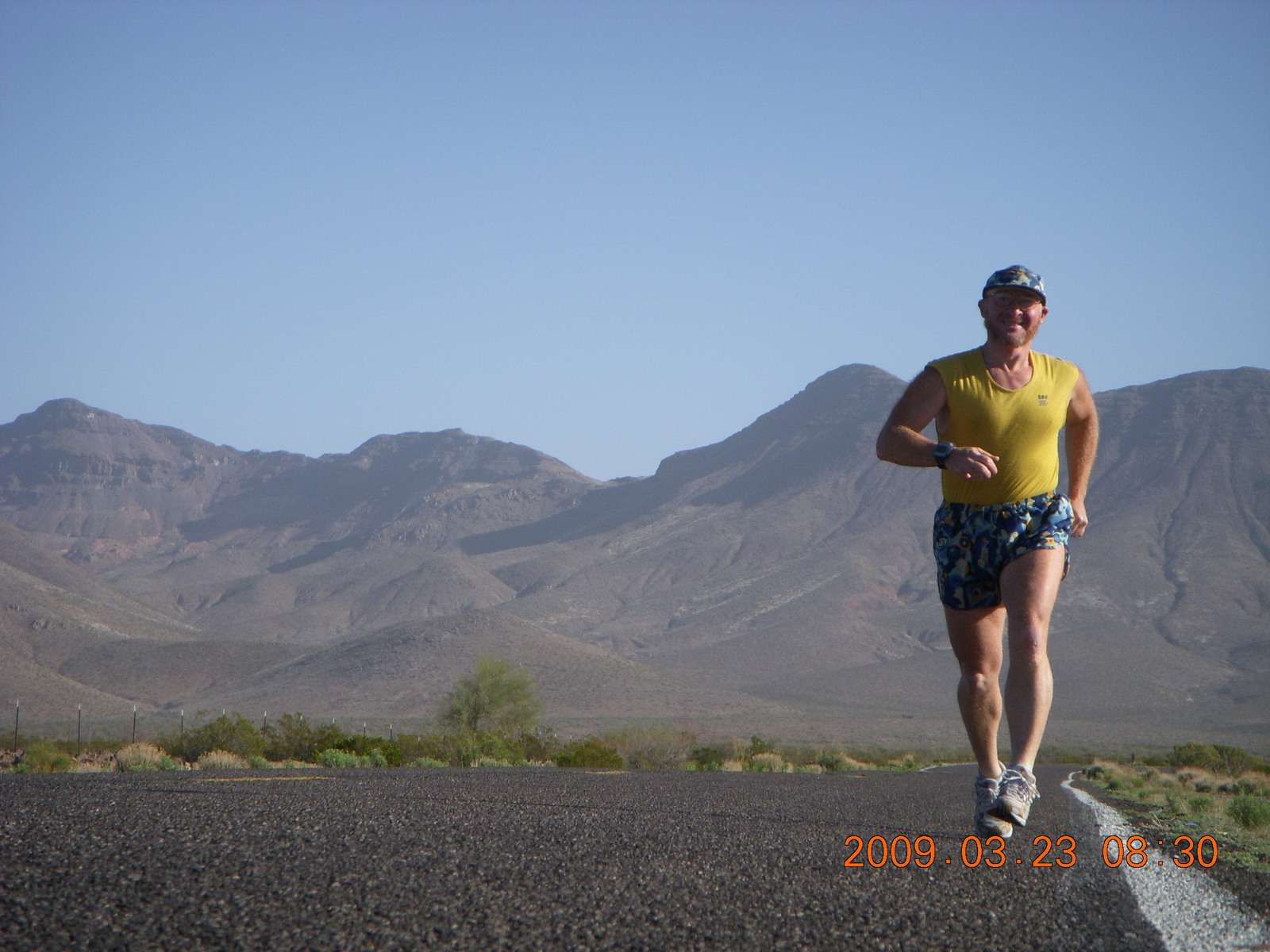
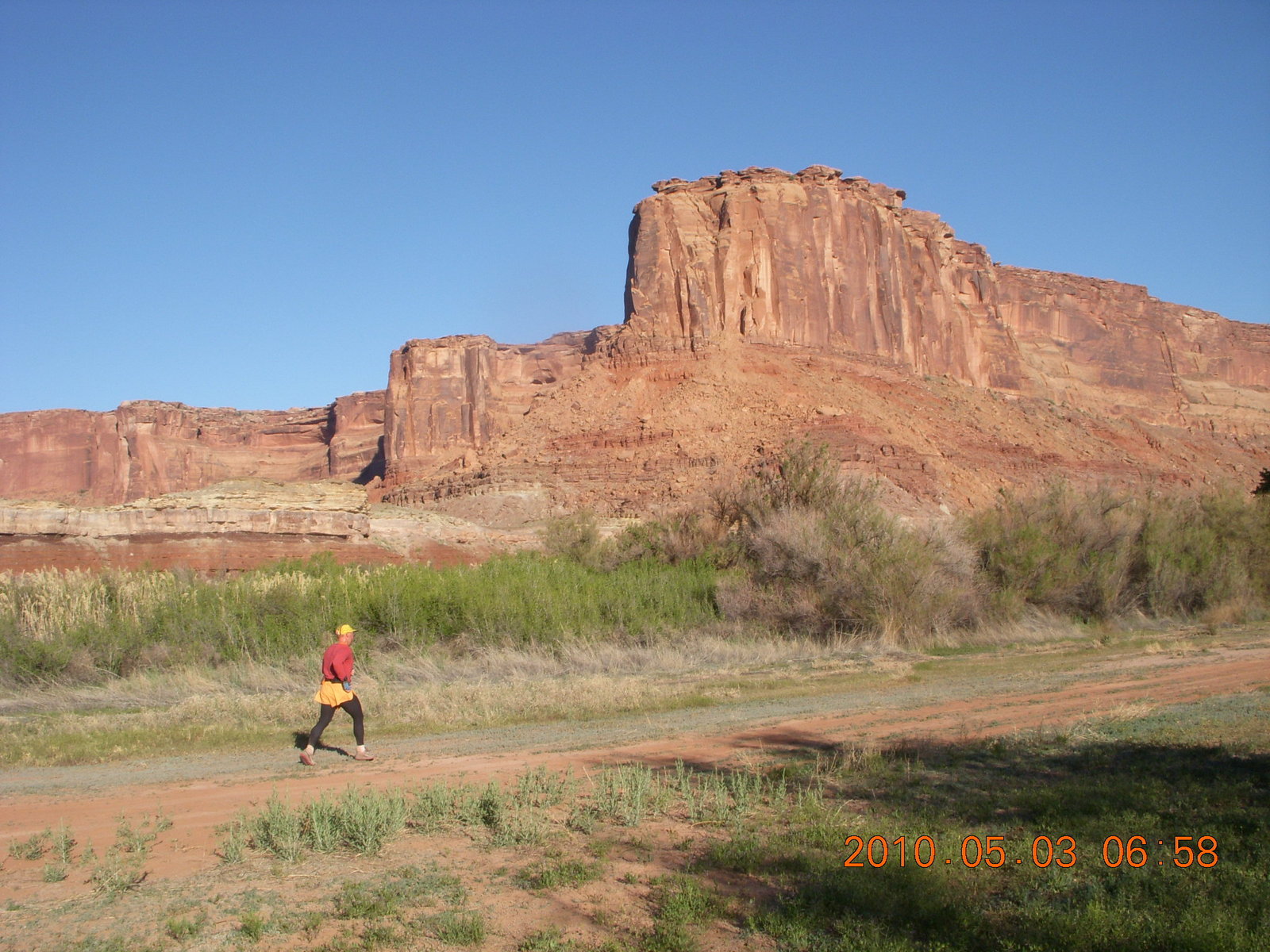
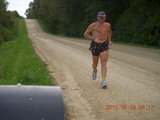
I have run in a lot of interesting places
and have become a bit famous for my aviation-running mix.
I still do the $100 hamburger without the cholesterol as I
run in a lot of airports,
127 of the 525 places I've landed.
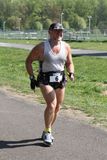 Being a morning runner means I see the world wake up.
I saw the wandering drunks in New Orleans at sunrise,
the English shopkeepers sweeping the sidewalk before opening,
street people in India sleeping outside under mosquito nets,
Chinese farmers herding livestock,
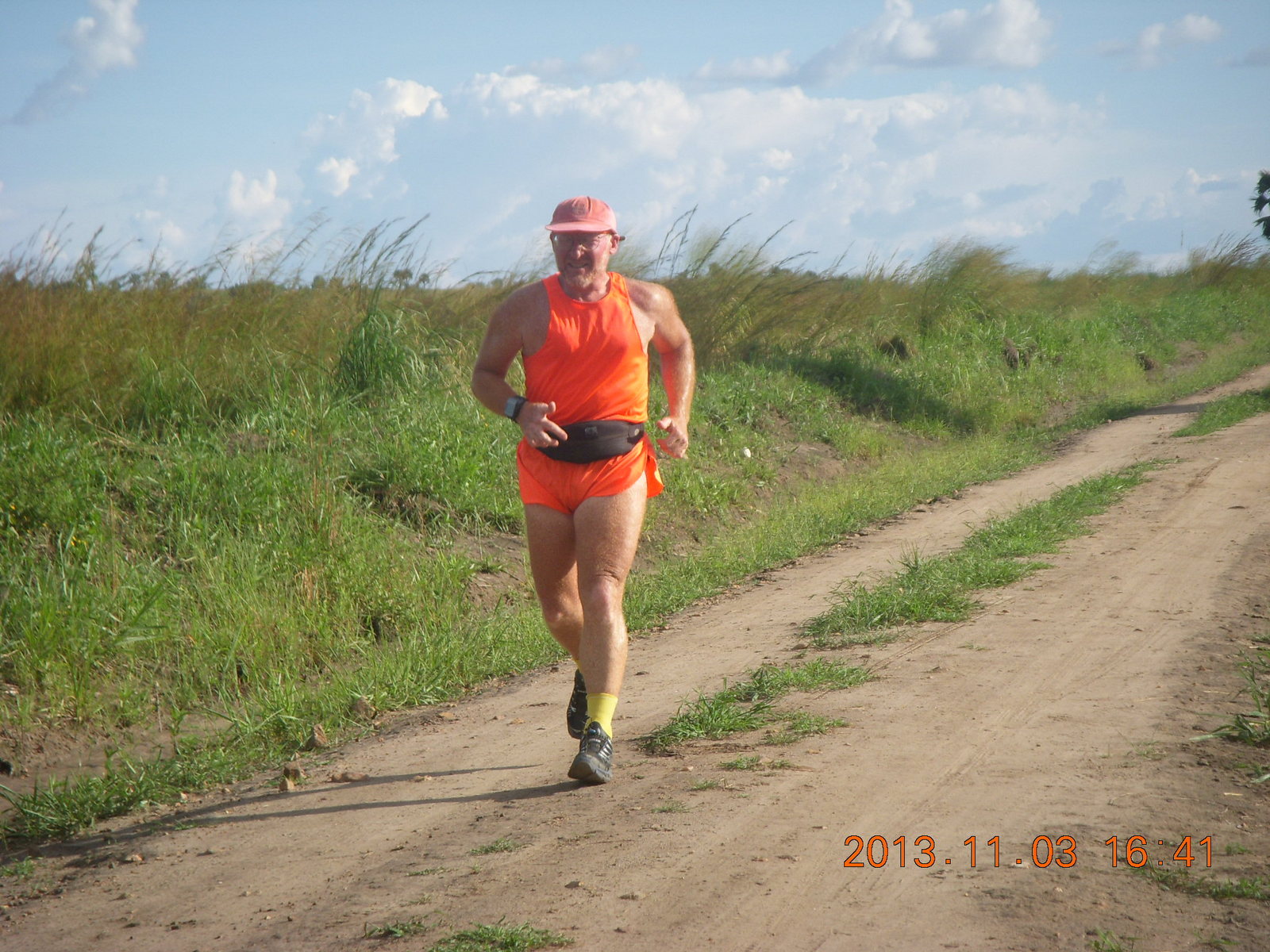
and people delivering bundles of wood on bicycles in Uganda.
I get "good morning" in various tongues
and the universal human message of a smile and a wave.
Even in places where I'm clearly a stranger from a strange land,
for my running hour I'm part of the scene.
Being a morning runner means I see the world wake up.
I saw the wandering drunks in New Orleans at sunrise,
the English shopkeepers sweeping the sidewalk before opening,
street people in India sleeping outside under mosquito nets,
Chinese farmers herding livestock,
and people delivering bundles of wood on bicycles in Uganda.
I get "good morning" in various tongues
and the universal human message of a smile and a wave.
Even in places where I'm clearly a stranger from a strange land,
for my running hour I'm part of the scene.
My first time running in a country that drives on the left,
it was Ireland,
I looked the wrong way and ran into a moving car.
I caught my foot under his wheel-well and bounced off my bum.
Only my pride was wounded, but I learned to be more careful.
Since then I've run in
seven
more countries that drive that way,
and I've been careful and lucky.
(I've been to
four
that where I did not run.)
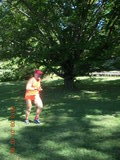 Being a morning runner means seeing sunrise all kinds of ways.
I've seen mountain and valley sunrises and on the prairie plains.
I've seen
sylvan
sunrises running on wooded trails
and morning-lit cityscapes.
I've seen first light become dawn in many places
and it is truly a joyful experience for me.
(My last two eclipses were celebrated by a run
during the partial eclipse leading up to totality.)
Being a morning runner means seeing sunrise all kinds of ways.
I've seen mountain and valley sunrises and on the prairie plains.
I've seen
sylvan
sunrises running on wooded trails
and morning-lit cityscapes.
I've seen first light become dawn in many places
and it is truly a joyful experience for me.
(My last two eclipses were celebrated by a run
during the partial eclipse leading up to totality.)
I'm not a religious person,
but if I were, then I would worship the sun,
the true giver of light and life on our planet.
If the first creatures that could tell light from dark
lived 1500 million years ago,
then my lineage has seen
five hundred thousand million sunrises
(that's 500,000,000,000, half a trillion),
and I still look forward to the next one.
There's something primal and wonderful about the sun,
especially the sunrise and,
even more especially, eclipses.
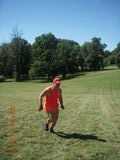 I'm not beyond or above liking looking better from my running.
I certainly don't share a runner's stylishly-slim body,
not now, not ever,
but my thick frame looks better doing a lot of miles on foot.
I've been told I have good legs,
1991 summer I was called a "beach god,"
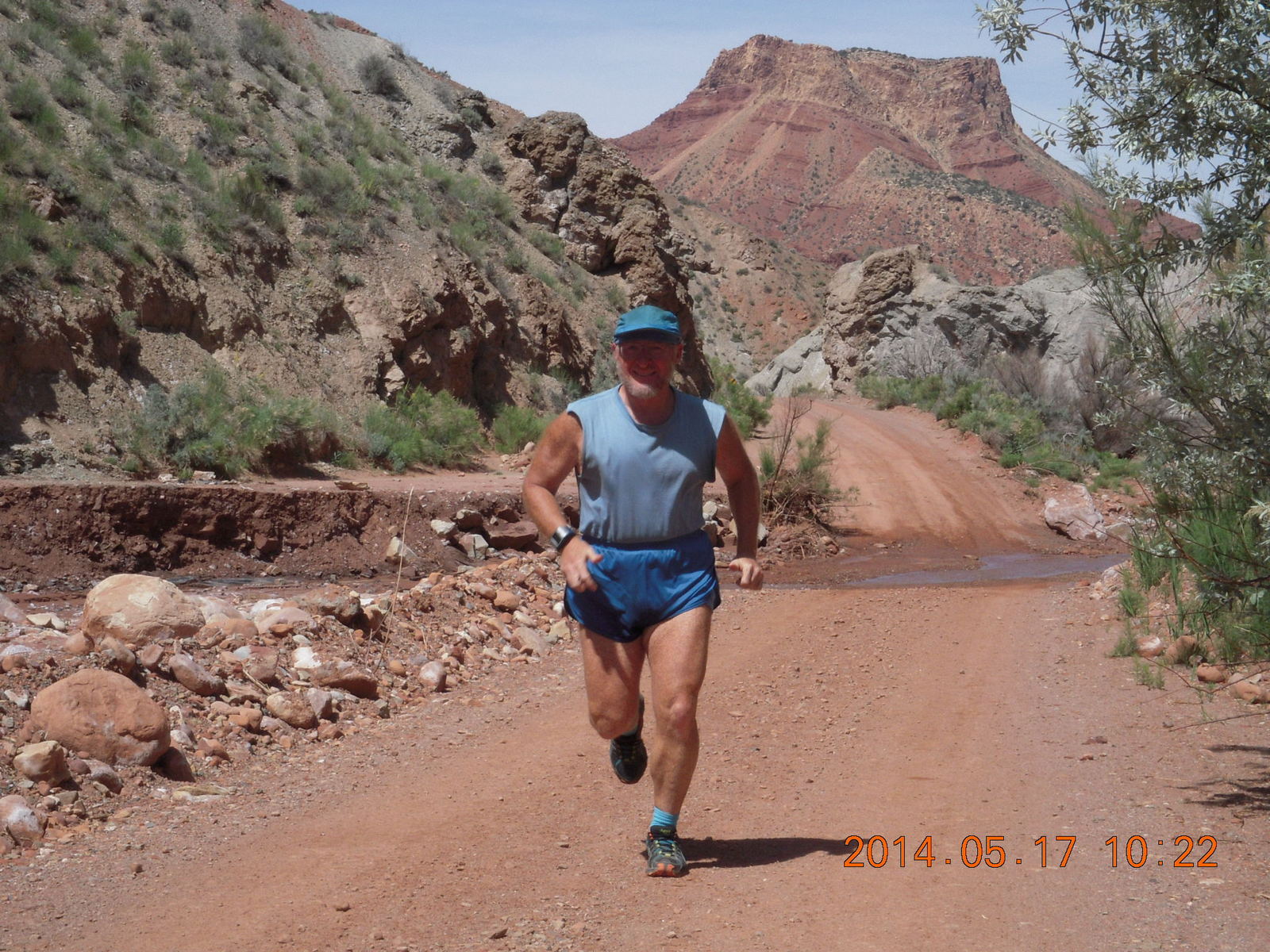
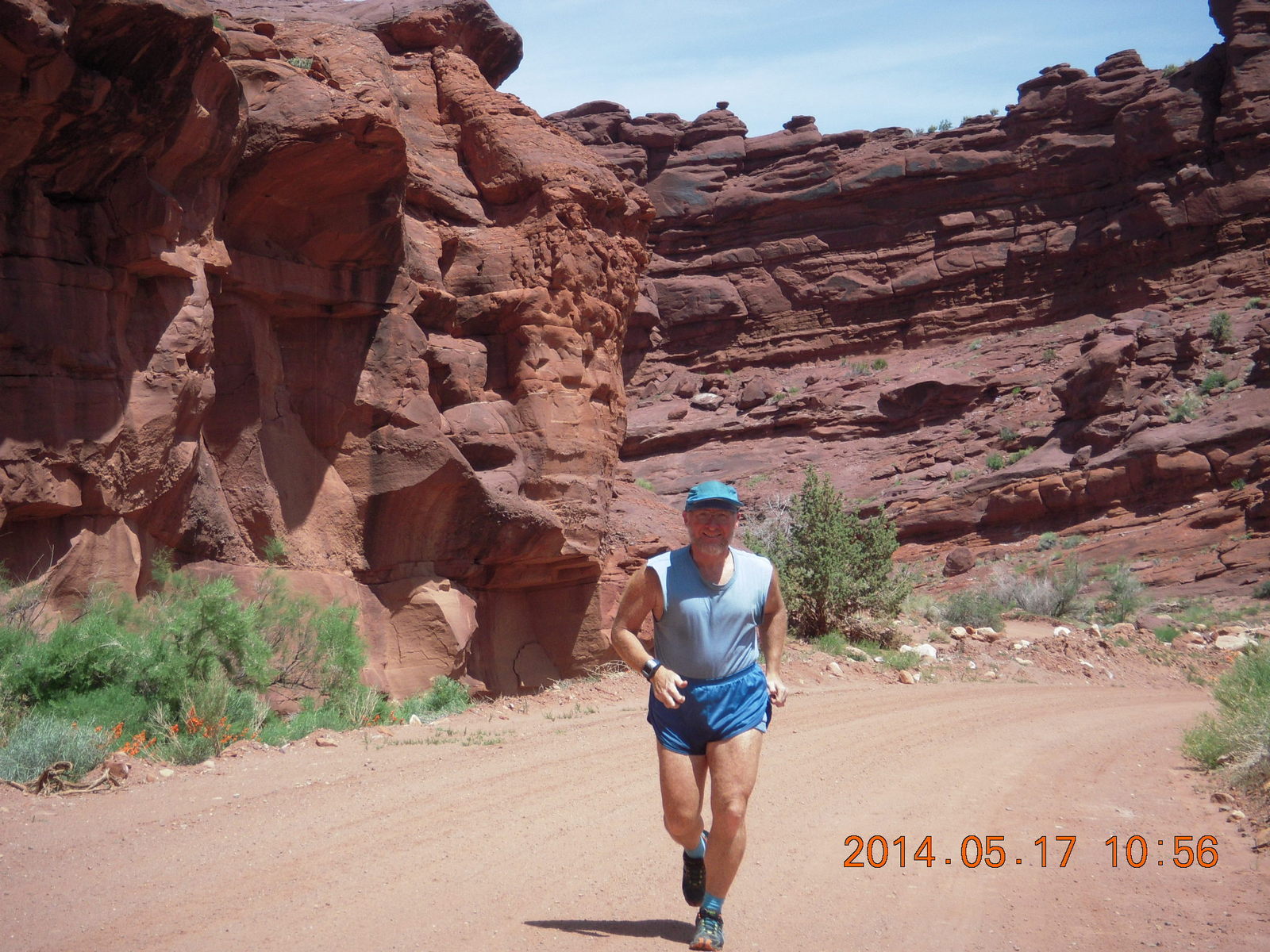
and even in 2014, in my decrepitude,
a friend reminded me I still look "buff."
(Flattery will get you everywhere.)
It would be nice if my running times
were as good as I look.
I have no illusions, I'm no Adonis, but I'm doing and looking okay.
Sometimes I have to add those three dreadful words,
"for my age."
I'm not beyond or above liking looking better from my running.
I certainly don't share a runner's stylishly-slim body,
not now, not ever,
but my thick frame looks better doing a lot of miles on foot.
I've been told I have good legs,
1991 summer I was called a "beach god,"
and even in 2014, in my decrepitude,
a friend reminded me I still look "buff."
(Flattery will get you everywhere.)
It would be nice if my running times
were as good as I look.
I have no illusions, I'm no Adonis, but I'm doing and looking okay.
Sometimes I have to add those three dreadful words,
"for my age."
So much has to go right to run.
Dem bones
all have to work, the
toe bone connected to the
foot bone connected to the
heel bone connected to the
ankle bone connected to the
shin bone connected to the
knee bone connected to the rest, all the way up,
all without inflammation or other injury.
Heart, lungs, and skeletal muscles
all have to work with enough efficiency and efficacy
to keep me moving.
In my case (along with quite a few others I suspect)
my herniated lower-back disks have to keep their clearance
from all the nerves that run along my spinal column.
There's a rhythm to running that takes a lot out of a body,
but puts a lot back into it as well.
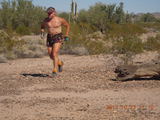 There's a rhythm to being a runner, too.
My day revolves around my morning run,
in a good way usually.
It gives me structure when I travel
and gives my day a good kick-start when I'm home.
There's a rhythm to being a runner, too.
My day revolves around my morning run,
in a good way usually.
It gives me structure when I travel
and gives my day a good kick-start when I'm home.
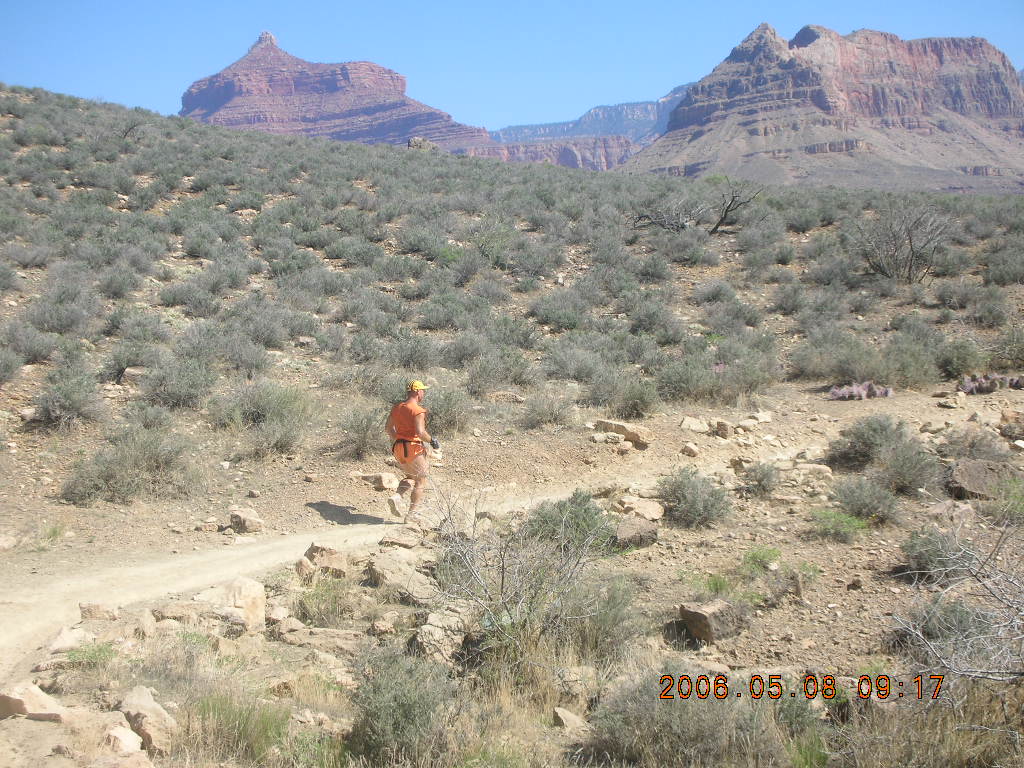
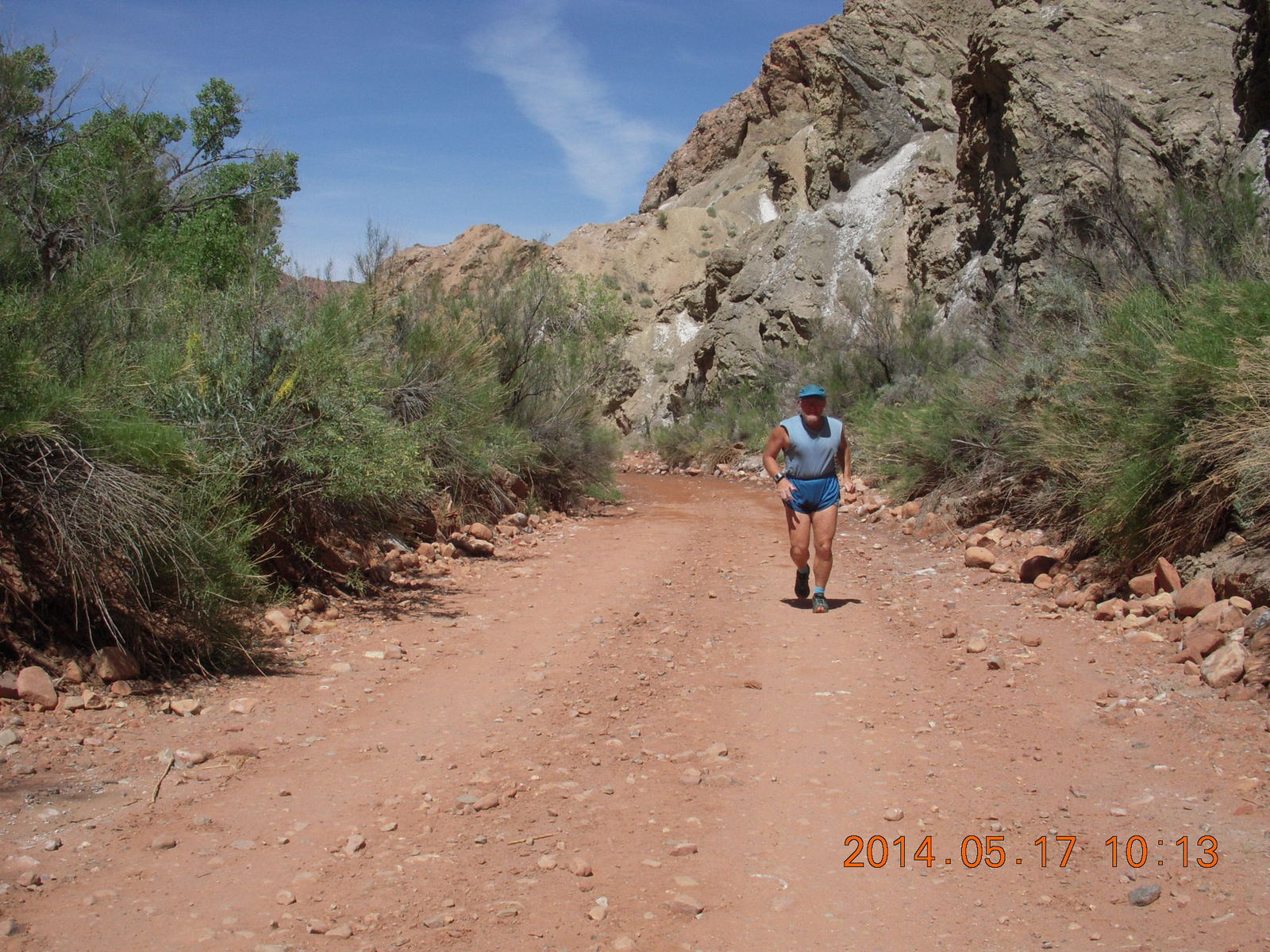
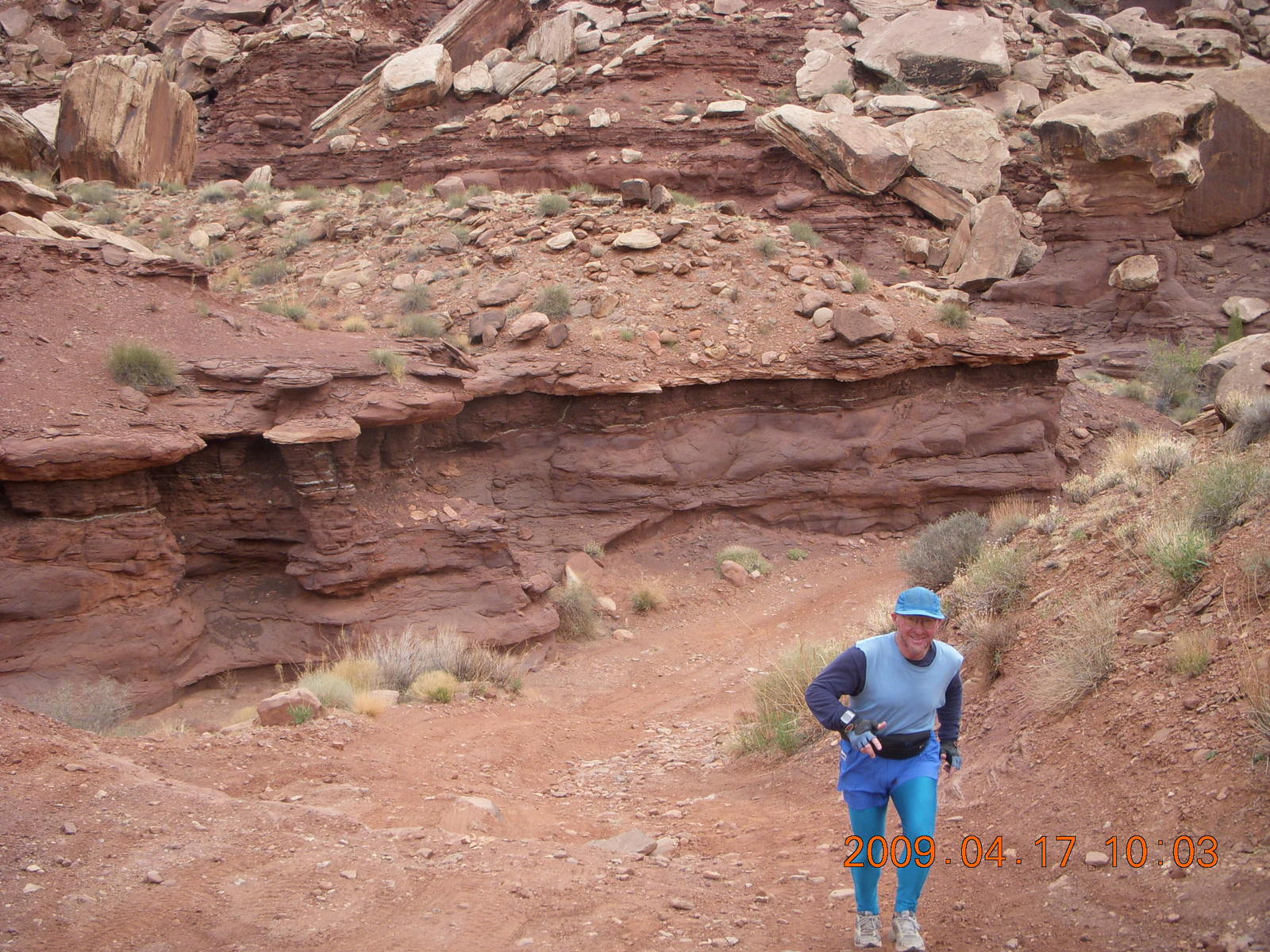
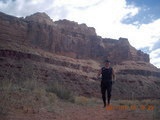
I've also combined running with hiking in my western-states adventures.
My favorite is the
Lathrop
trail at Canyonlands National Park.
It's 17.5 Km (eleven miles) down
from the Island in the Sky to the Colorado River
and, yes, the same distance back up.
Half of those twenty-two miles are runnable,
easy trails or dirt roads, and I hike the other half.
It's a full day, eight or nine hours worth,
and incredibly beautiful.
The price (in addition to the effort of getting there) is fitness.
My latest efforts have found me really tired coming back up,
and there is no DNF option.
I'm all alone out there.
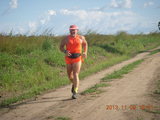 For my western-states adventures like
hiking down and back up the Grand Canyon
or my Lathrop-trail adventure in Canyonlands,
the standard is fixed.
There is no DNF (did-not-finish),
only DOA (dead-on-arrival).
Making it ninety percent of the way doesn't count.
The price of the beauty of these adventures
is an absolute level of fitness.
The other thing that seems to be an absolute standard
is how good running fast feels.
I've had good, hard runs in the past decade,
maybe that nice 18 Km (eleven miles) from Club SAR
in ninety-nine minutes and it felt good and nine minutes per mile,
but nothing like what it felt like to do that same distance
in eighty minutes at seven minutes per mile.
Absolutists have the sound-byte "better is better,"
but the reality of absolute athletics is "better feels better."
For my western-states adventures like
hiking down and back up the Grand Canyon
or my Lathrop-trail adventure in Canyonlands,
the standard is fixed.
There is no DNF (did-not-finish),
only DOA (dead-on-arrival).
Making it ninety percent of the way doesn't count.
The price of the beauty of these adventures
is an absolute level of fitness.
The other thing that seems to be an absolute standard
is how good running fast feels.
I've had good, hard runs in the past decade,
maybe that nice 18 Km (eleven miles) from Club SAR
in ninety-nine minutes and it felt good and nine minutes per mile,
but nothing like what it felt like to do that same distance
in eighty minutes at seven minutes per mile.
Absolutists have the sound-byte "better is better,"
but the reality of absolute athletics is "better feels better."
Recently, my best effort was 4 Km in 27,
two and a half miles under eleven minutes each,
a score of 50 on my scale.
I can still fly to back-country airstrips and run a mile or two,
but it sure was nicer when I could run six or eight miles,
or the twelve miles I ran 2009 September 30 at
Payson Airport (PAN).
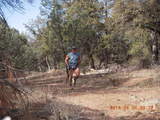 I see two paths, one hopeful and one not.
If I can get back in shape in the next three years,
then I figure I might get ten half-decent years
before I reach my dotage at three score and ten (70).
(Those running well after seventy
are usually people who ran superlatively well in their youth,
which I did not, but maybe I can do okay in my sixties.)
On the other hand, if I continue to decline,
then I'm soon going to lose a part of my life
I have held onto for 42 years.
That prospect terrifies me.
I see two paths, one hopeful and one not.
If I can get back in shape in the next three years,
then I figure I might get ten half-decent years
before I reach my dotage at three score and ten (70).
(Those running well after seventy
are usually people who ran superlatively well in their youth,
which I did not, but maybe I can do okay in my sixties.)
On the other hand, if I continue to decline,
then I'm soon going to lose a part of my life
I have held onto for 42 years.
That prospect terrifies me.
There are all kinds of visions about what we are and who we are.
I believe we are what we do, mostly.
I was a short, stocky, slow high-school kid who became a runner.
I didn't play football, soccer, or even tennis.
I chose the loneliness of the long-distance runner,
doing my long runs alone but enjoying the comraderie
of sharing the sport with other runners.
I enjoy the intensity of my sport,
the totality of effort it demands.
Even my glory days weren't that glorious,
In college I was an 11:01 high-school two-miler
sitting at a table
with eight or ten guys who ran under 9:10
when they were in high school.
Athletes who are fast enough not to think much of my running times,
then or now,
still respected the mileage I ran and the passion I maintained.
My airport runs, often from back-country airstrips,
are still a trademark of The Adam,
part of what I am,
or at least what I have been
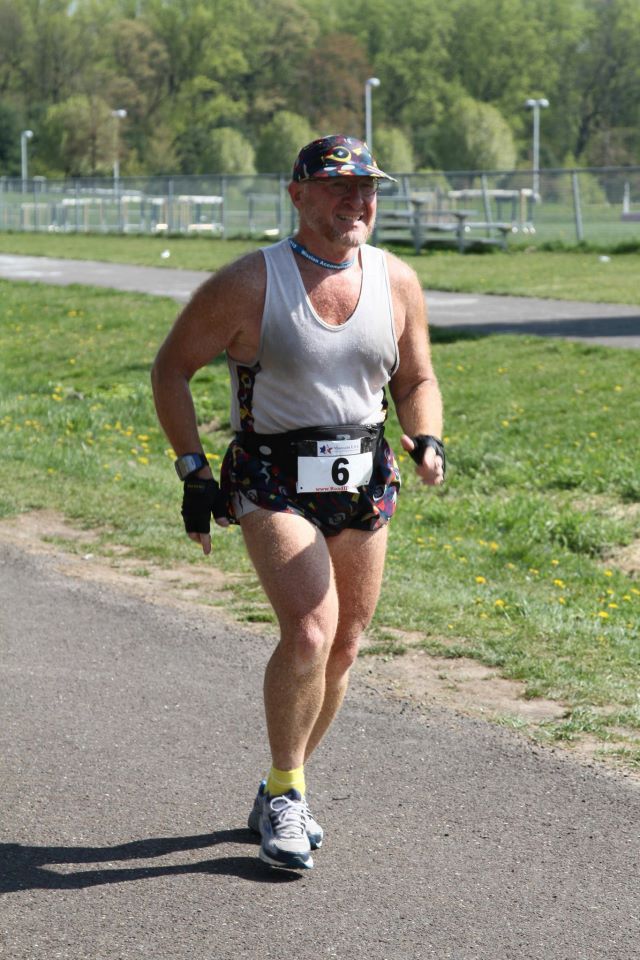
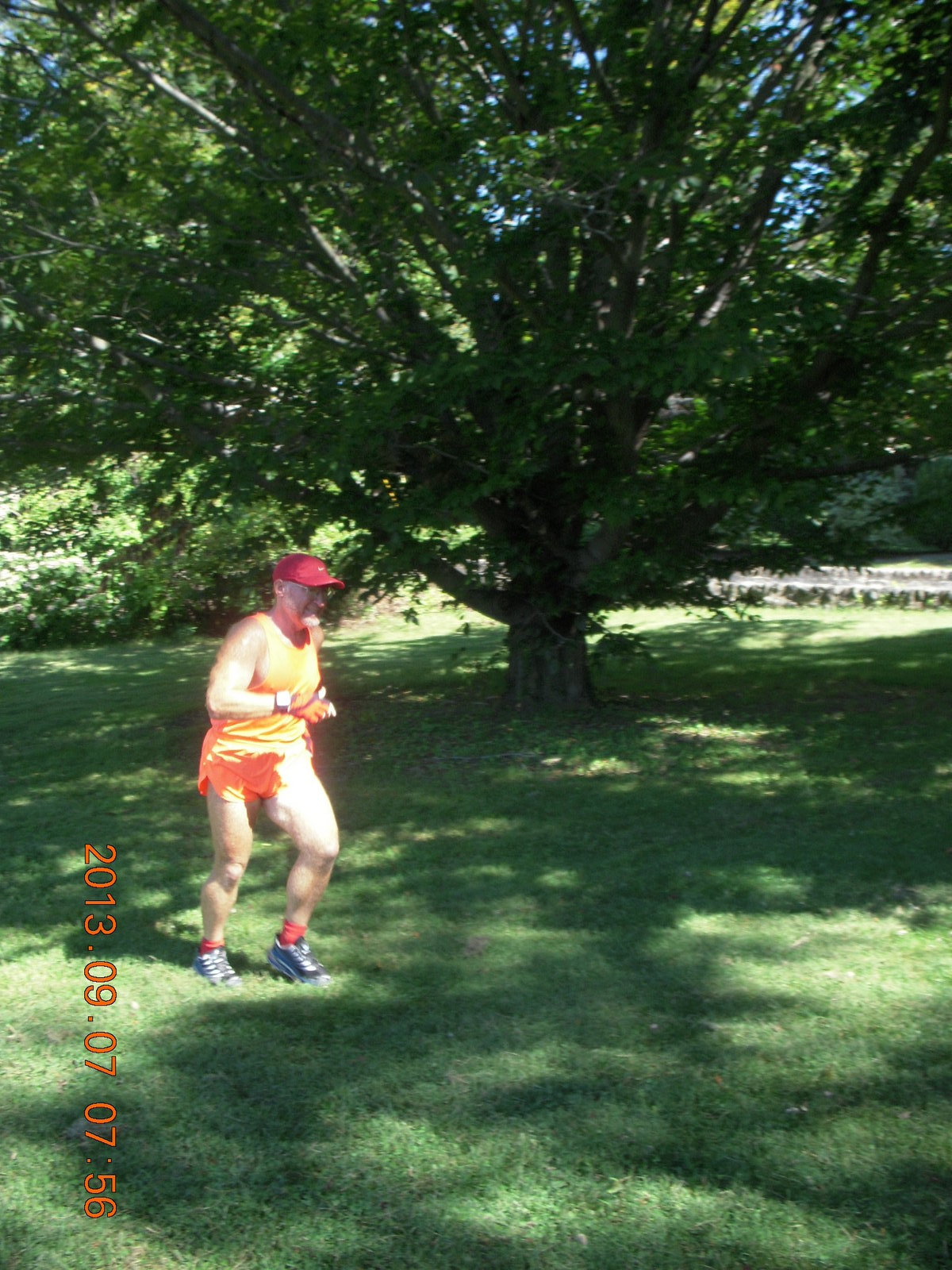
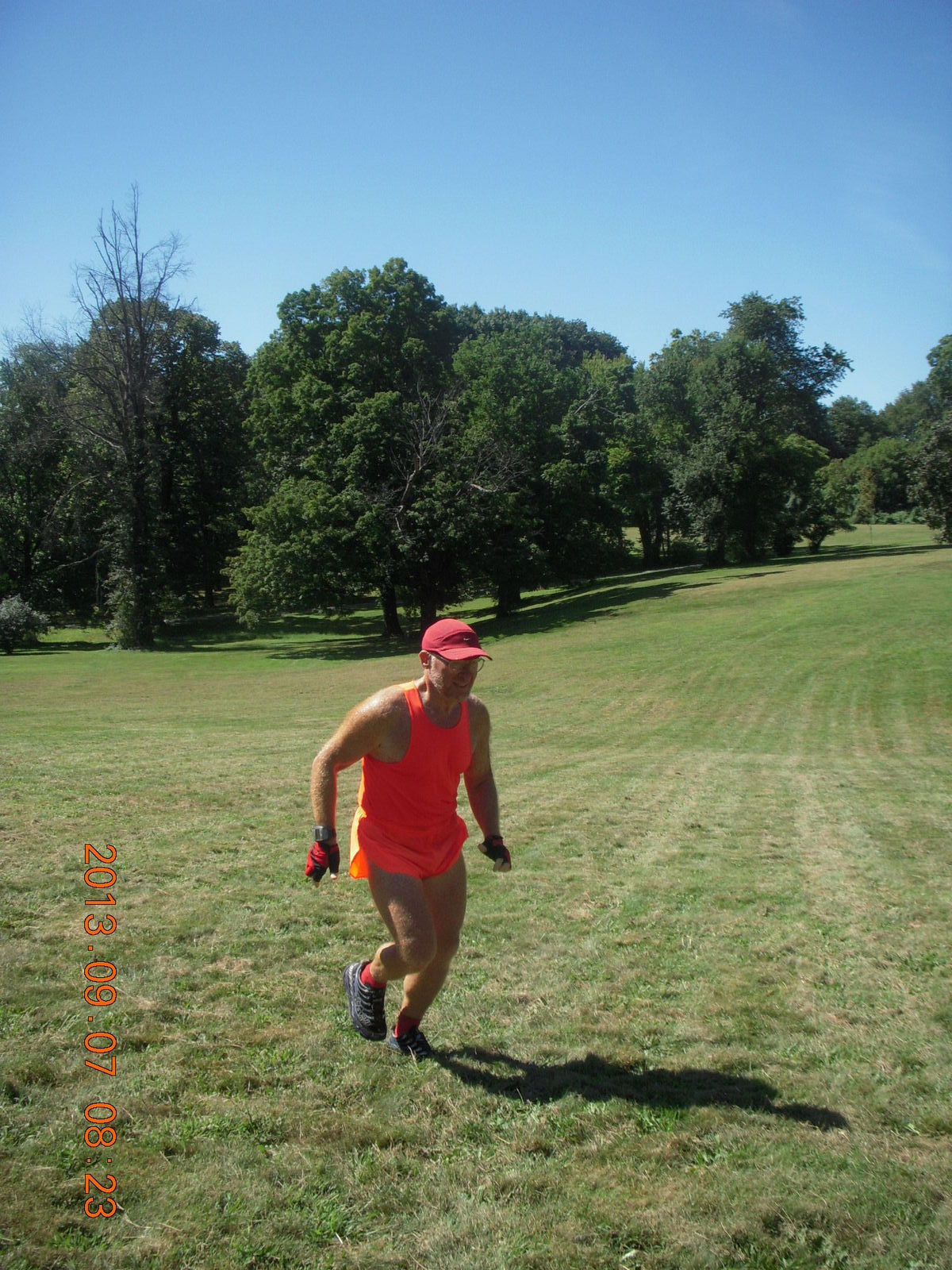
and would like to continue being.
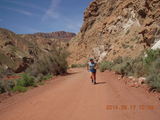 The Cheltenham alumni race on 2013 September 7
marked forty years since running in high school.
Forty years is a long time, an achievement in and of itself,
something I'm proud of.
I didn't just survive those four decades,
All that time
I managed to keep running, to keep moving, to keep up my effort.
Yeah, I'm proud of that.
The Cheltenham alumni race on 2013 September 7
marked forty years since running in high school.
Forty years is a long time, an achievement in and of itself,
something I'm proud of.
I didn't just survive those four decades,
All that time
I managed to keep running, to keep moving, to keep up my effort.
Yeah, I'm proud of that.
So here's a question:
Am I a role model for young runners?
In 2010 I would have said, "Yes, absolutely.
I've been out there doing this sport coming up on forty years.
Maybe my last marathon is behind me,
but I'm still running half-marathon races under two hours,
still getting out there and running ten miles before breakfast,
still making athletics a fundamental part of my life."
I thought a sixteen year old runner
doing three miles in eighteen minutes
would look at me and say,
"Yeah, I'd like to be like him in forty years."
 Now I'm not so sure.
5000 meters in 35 minutes isn't quite there.
I'd like to think they still admire me for
being out there four decades,
but maybe they're thinking, "Oh, gosh, this could happen to me!"
One big difference is younger friends who go out running on a lark
don't do what I could do three years ago,
I was at an athletic level they could aspire to,
but easily surpass what I'm doing now.
And, yes, that frustrates me,
not so much being beaten as much as not being able to do it better.
Now I'm not so sure.
5000 meters in 35 minutes isn't quite there.
I'd like to think they still admire me for
being out there four decades,
but maybe they're thinking, "Oh, gosh, this could happen to me!"
One big difference is younger friends who go out running on a lark
don't do what I could do three years ago,
I was at an athletic level they could aspire to,
but easily surpass what I'm doing now.
And, yes, that frustrates me,
not so much being beaten as much as not being able to do it better.
Still, I don't want to live in my past, at least not entirely.
"I am a runner" sounds good to me,
"I was a runner" sounds like a has-been, a once-a-runner ex-athlete.
I can still do difficult hikes on hilly trails
and a younger, fairly-fit hiking friend
says I gave him a good workout up to Angels Landing
at Zion National Park in 2013 December.
Tennis players take up golf (on their way to bridge?)
and runners can become walkers or hikers.
Even in my deteriorated state these days,
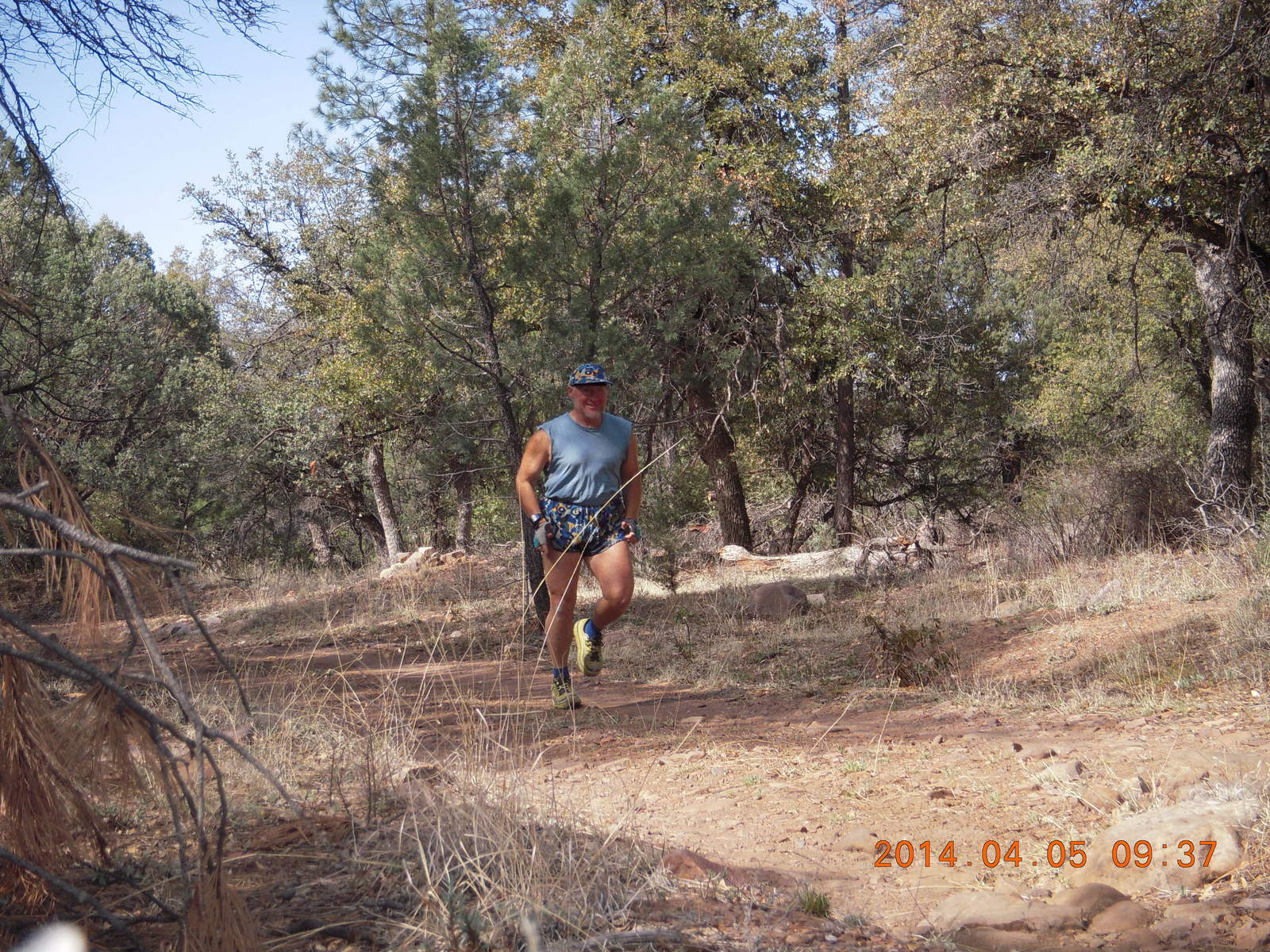
I still do long, hard hikes
at Bryce Canyon and Zion
National Parks.
 My resting pulse is still fifty-five beats per minute
which suggests a large capability of moving blood through my body.
If fitness is the ability to do physical work
(running in my case),
then one measure is how much blood
(with energy in the form of sugar and oxygen)
can get to muscles doing that work.
Assuming we all do the same, minimal work at idle,
a low resting pulse suggests I have a larger reserve of energy use.
My resting pulse is still fifty-five beats per minute
which suggests a large capability of moving blood through my body.
If fitness is the ability to do physical work
(running in my case),
then one measure is how much blood
(with energy in the form of sugar and oxygen)
can get to muscles doing that work.
Assuming we all do the same, minimal work at idle,
a low resting pulse suggests I have a larger reserve of energy use.
My model of training has always been a ramp-up philosophy of effort.
I start moving and keep moving faster until some limit is reached.
For a usual training run,
I judge the effort where I can "train without strain,"
where I put out appropriate levels of breathing-hard effort
that I can sustain for the duration of my run
and that won't injure me.
That level of effort varies from conversational-level breathing
on regular-run days
to hard breathing for "tempo runs"
all the way to flat-out gasping for air at race effort.
Sometimes aches and pains, even injury, take their toll
and that effort is very low.
Recently,
I reach a level of aches or exhaustion very quickly when running,
and that frustrates me.
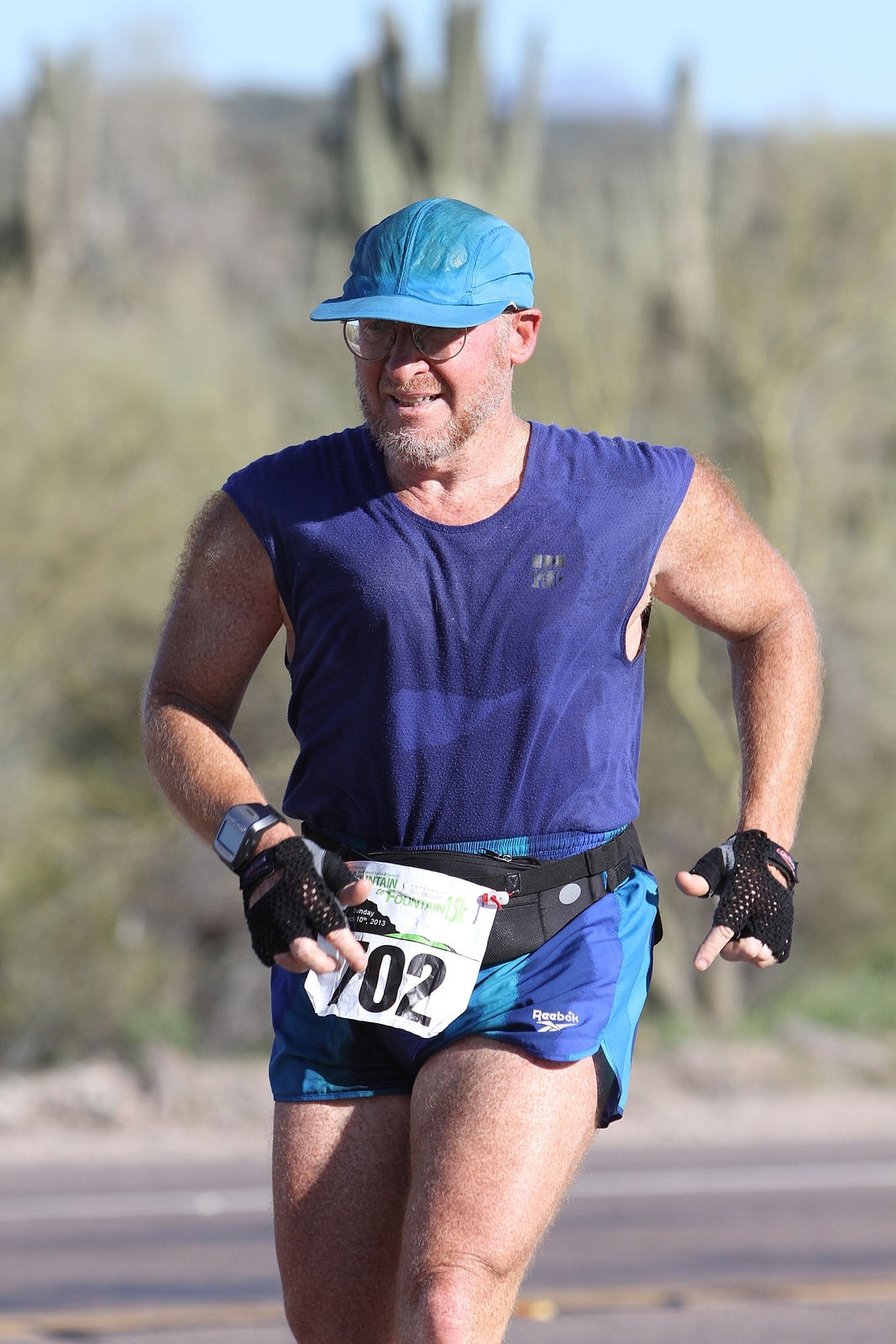
| My Personal Records |
| Distance |
Year |
Time |
Per Mile |
Score |
| half mile |
1974 |
2:21 |
4:42.0 |
93 |
| mile |
1974 |
5:12 |
5:12.0 |
92 |
| two mile |
1974 |
11:01 |
5:30.5 |
96 |
| three-mile cross country |
1973 |
17:45 |
5:55.0 |
94 |
| 5000 meters |
1992 |
21:02 |
6:46.2 |
83 |
| 10000 meters |
1992 |
42:30 |
6:50.4 |
90 |
| ten mile split |
1975 |
61:00 |
6:06.0 |
108 |
| half marathon split |
1975 |
81:00 |
6:10.7 |
111 |
| half marathon |
1991 |
94:30 |
7:12.5 |
95 |
| marathon |
1976 |
3:03:30 |
6:59.9 |
108 |
 So we'll see if I "am" or "was" a runner.
The old joke goes like this,
"I may not ever be as good as I once was,
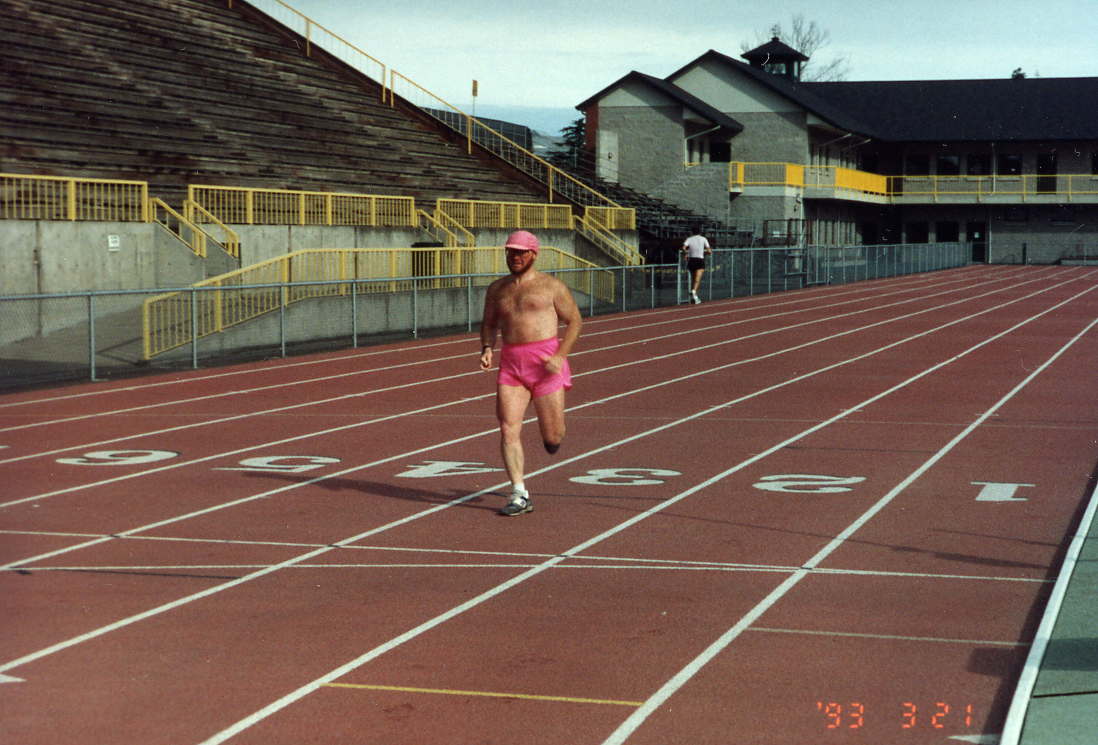
but I'm as good once as I ever was."
I'm not as good as I once was,
or even as good once as I ever was,
not after the kind of running I did at eighteen.
If I can do two or three miles at ten-minutes each,
then I won't be happy, but I'll be okay.
So we'll see if I "am" or "was" a runner.
The old joke goes like this,
"I may not ever be as good as I once was,
but I'm as good once as I ever was."
I'm not as good as I once was,
or even as good once as I ever was,
not after the kind of running I did at eighteen.
If I can do two or three miles at ten-minutes each,
then I won't be happy, but I'll be okay.
So wish me luck.
2017 December 15 update:
Running is opium, a high, a rush, a wonderful sensation
I enjoyed for several decades, even in my ever-slowing, aging process.
In the last couple of years, my knees have become arthritic
to the point where only very-short, occasional runs are practical.
In addition, I've been having breathing problems.
Unless something changes dramatically, my running days are over.
My running-opium addication is being grudgingly satisfied
by a combination of bicycling, hiking, and gym workouts,
the equivalent of giving up heroin for methadone.
It's not the same, but I'm enjoying it and
I'm staying an athlete at some level.
I leave the sport a high-school cross-country alumnus,
fifth man varsity, having run the first thirty alumni runs,
and still actively involved with my high school team
in Cheltenham, Pennsylvania.
I leave the sport with thirteen marathons
(including bicentennial Boston in 1975 and
the five-borough New York Marathon in 1976)
and "a whole lotta" half marathons and other shorter races
in a lot of places.
I saw the sport grow from thousands to millions.
I leave the sport having run in a whole bunch of interesting
and beautiful places through travels, national-park visits,
and my aviation hobby.
I leave the sport as a role model
putting my heart and soul into it
for four decades.
The Adam 2017-2019 Calendar pictures
(18 months times two)
THE ADAM HOME PAGE
adam@the-adam.com
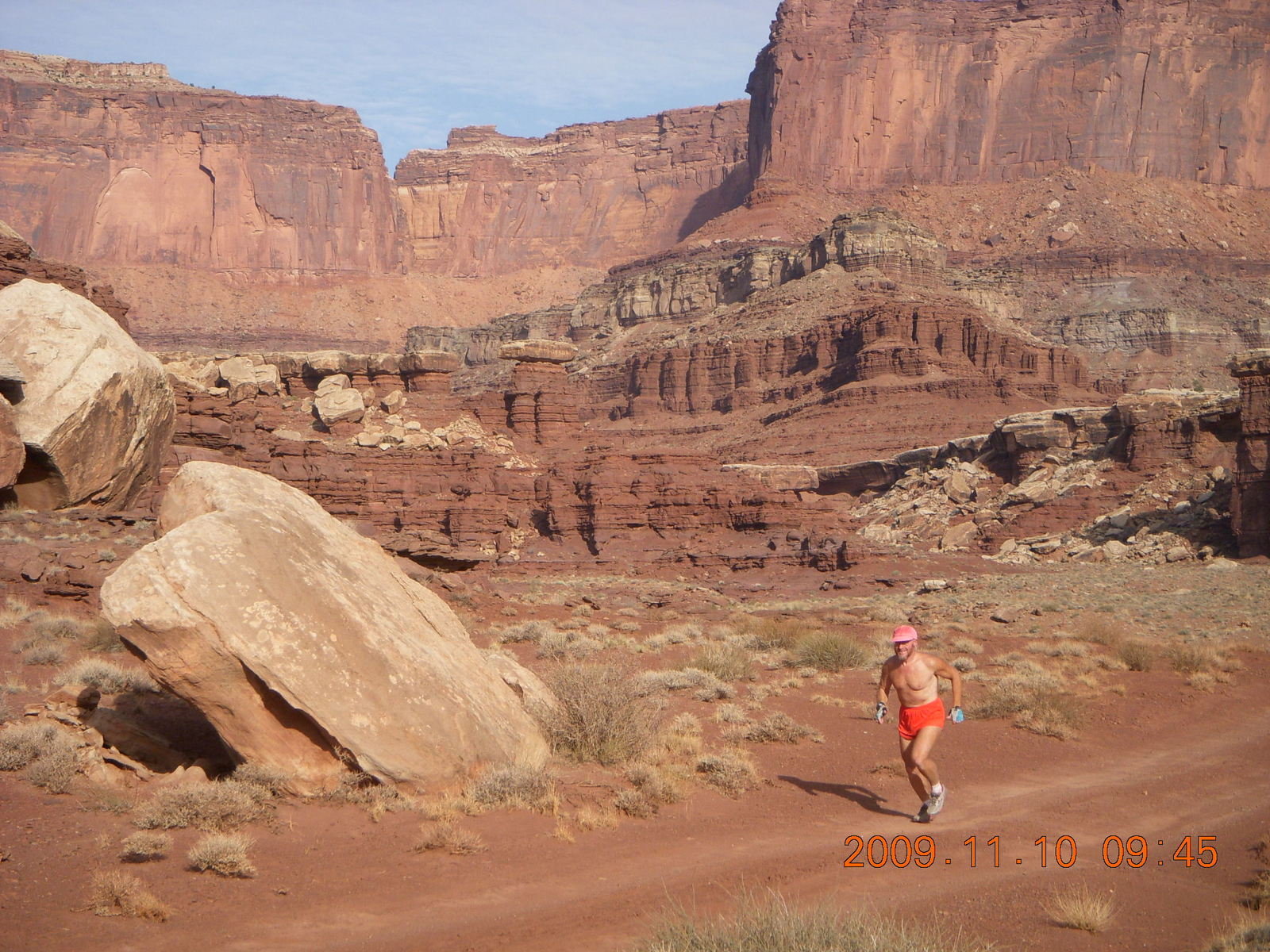 I wasn't born a runner.
I'm the wrong build and my childhood idea of exercise
was watching cartoon characters doing athletic things
on television.
When I was in junior-high school
(grades seven through nine in my district and time)
we had a gym teacher named Philip Finkeldey.
That name being too complicated for a bunch of seventh graders,
he went by the name Mr. Fink.
He coached the three "tough" sports, football, wrestling, and track,
and his theme in gym class was improvement.
One area was the 600-yard run (550 meters)
where a student got an automatic one-grade boost in his report card
for a ten-second improvement in his time between fall and spring.
One could "dog it" in the fall, but I never did.
I may have longed to run the Boston Marathon,
but it was enough just to run 600 yards without stopping.
I wasn't born a runner.
I'm the wrong build and my childhood idea of exercise
was watching cartoon characters doing athletic things
on television.
When I was in junior-high school
(grades seven through nine in my district and time)
we had a gym teacher named Philip Finkeldey.
That name being too complicated for a bunch of seventh graders,
he went by the name Mr. Fink.
He coached the three "tough" sports, football, wrestling, and track,
and his theme in gym class was improvement.
One area was the 600-yard run (550 meters)
where a student got an automatic one-grade boost in his report card
for a ten-second improvement in his time between fall and spring.
One could "dog it" in the fall, but I never did.
I may have longed to run the Boston Marathon,
but it was enough just to run 600 yards without stopping.